Was the notorious Stanford Prison Experiment a complete fabrication?

A French historian specializing in science has conducted an in-depth investigation into the real events behind the Stanford prison experiment, uncovering that the 'guards' were deliberately instructed to act with cruelty. His research has now been translated into English. View pictures in App save up to 80% data. Source: BBC/Stanford University. A recent translation of a 2018 work by French science historian Thibault Le Texier calls into question the assertions made by one of psychology's most renowned experiments. Exploring the Stanford Prison Experiment: Unraveling the Myth, published recently in English, documents serious limitations of the study – including that student “guards” were actually coached to dehumanise their “prisoners” – and asks how such a flawed experiment became so influential. A notorious 'cell' located in the basement of a university You’ve likely heard of the Stanford prison experiment. In 1971, 24 young male volunteers were randomly assigned to the roles of “inmates” and “guards” in a pretend prison in the basement of Stanford University’s psychology department. The circumstances escalated rapidly. By the second day, the volunteers assigned as guards had started to inflict psychological torment on the inmates. Deprived of clothing, blinded by hoods, bound by chains, and subjected to starvation and sleep deprivation, the inmates experienced severe psychological distress, with half of them experiencing nervous breakdowns. Consequently, by the sixth day, the experiment – originally intended to continue for two weeks – was abruptly terminated. The experiment was conducted by social psychologist Philip Zimbardo, who died last year at the age of 91. He argued that the transformation of seemingly normal people into cruel guards and passive prisoners was proof that social situations have the power to corrupt human behaviour. View pictures in App save up to 80% data. Inmates were required to don short smocks featuring identification numbers. Source: PirsonExp.org His sensational findings and the dramatic story of the experiment, illustrated with photos of uniformed guards in aviator shades and batons standing threateningly over cowering and hooded prisoners, made Zimbardo and his experiment famous. Since it was conducted over five decades ago, the lessons from the experiment have been applied to a burgeoning number of situations beyond prison. By 2007 Zimbardo used it to explain corporate fraud, military torture, cult behaviour and even genocide. A newly released English version of French scholar Thibault Le Texier’s 2018 work reveals a more intricate and concerning narrative surrounding the renowned study. It raises questions about Zimbardo’s credibility as the storyteller of his own findings. Critiques of the experiment are not a recent development; concerns regarding its methodology and Zimbardo's claim that situations can dominate our personalities have been raised since 1975. However, Le Texier's comprehensive findings, now accessible in English for the first time, provide an in-depth narrative of the events that transpired behind the scenes. Trained to be ruthless By utilizing archival materials, previously unreleased video recordings, transcripts, and in-depth interviews with those involved – such as the guards, inmates, and researchers – Le Texier constructs a detailed chronological narrative of the experiment's progression. Far from being swept up in the situation, archival sources show the guards’ brutality was rehearsed. Contrary to official accounts, before the experiment they were coached by the research team in how to create a psychologically hostile environment. Zimbardo provided the guards with a set of regulations to enforce, along with methods intended to dehumanize the inmates. As the experiment progressed, the staff motivated the guards to act aggressively and scolded those who showed too much compassion. View pictures in App save up to 80% data. The 'inmates' were confined to stark cells, with three individuals sharing each one. Source: PrisonExp.org In comparison, the inmates were not well-prepared. Many of them imagined their time behind bars would be filled with reading or watching television in their cells. Therefore, they were taken aback by the humiliations they faced, the lack of cigarettes and books, and other forms of entertainment, as well as the often capricious and shifting regulations. The reactions of the prisoners and guards to the circumstances varied significantly. While some guards embraced their responsibilities with fervor, others showed compassion towards the inmates, sneaking in snacks and cigarettes. One guard even decided to resign. Certain inmates chose to work together, while others stood firm against authority, and a few even staged a rebellion. One individual initiated a hunger strike. While many sought freedom, they quickly realized that, contrary to what they had been promised, leaving was not an option for them. Their release would only be granted in the event of a medical or psychiatric crisis. Le Texier discovered that only three prisoners were set free due to claims of emotional turmoil, and at least one of them had pretended to be in distress. The experiment was halted due to potential failure risks. Le Texier observed that by the sixth day, the guards were growing more ineffective as the remaining prisoners continued to resist. An unanticipated visit from a lawyer brought to light questions regarding the legality of detaining volunteers without their consent. Both of these elements contributed to the sudden conclusion of the experiment. A lasting hold on the shared awareness of society. According to Le Texier, several key elements have contributed to the lasting notoriety of Zimbardo's experiment, including his adeptness at engaging with the media, his talent for making complex ideas accessible to the public, the backing of his university, and the predominantly uncritical reception of his results. It continues to exert a powerful grip on the public imagination, largely through the promotional flair of its creator. View pictures in App save up to 80% data. In the Stanford prison experiment, the guards imposed numerous humiliations on the 'prisoners.' Source: PrisonExpo.org Le Texier’s book raises important questions about the cultural and political factors that shape research. For example, Zimbardo’s study was conducted during a period of intense anti-authoritarianism and against the backdrop of the 1971 Attica prison riot, the deadliest prison uprising in the United States. Le Texier's work offers valuable insights into science communication and highlights how media-savvy scientists can effectively create and share compelling narratives. The Stanford prison experiment may be downplayed or criticized in academic literature for its exaggerated assertions, yet it is improbable that it will fade from the collective consciousness of the public. According to Le Texier, the experiment has captured our shared awareness so strongly that, although its results may be inaccurate, it seems to convey a significant moral teaching. Zimbardo had a unique ability to address our deep-seated desire for solutions to the pressing issues of our era. While it may lack solid theoretical grounding and resemble a morality tale masquerading as scientific inquiry, the lasting notoriety of the Stanford prison experiment lies in its perceived insights into how ordinary individuals can descend into malevolence. This narrative continues to resonate, as it offers a compelling tale. Sale View pictures in App save up to 80% data. Exploring the Stanford Prison Experiment: Unraveling the Myth Hardcover Book Le Texier, Thibault (Author) English (Publication Language) 210 Pages – 08/09/2024 (Publication Date) – Springer (Publisher) Gina Perry, Science historian with a specific interest in the history of social psychology., The University of Melbourne This article is republished from The Conversation under a Creative Commons license. Read the original article.

Read more
The James Webb Space Telescope has reached a significant milestone by discovering 44 ancient stars.

View pictures in App save up to 80% data. fabio lamanna - stock.adobe.com - for illustrative purposes only Thanks to NASA's James Webb Space Telescope (JWST), a team of astronomers from the University of Arizona’s Steward Observatory has reached a significant breakthrough in cosmic research. Through the observation of a galaxy located approximately 6.5 billion light-years away, which dates back to a time when the universe was only half as old as it is now, researchers discovered 44 distinct stars. This achievement was enabled by gravitational lensing and the light-gathering capabilities of the JWST. As a result, this discovery has established a new record for the highest number of individual stars observed in a distant galaxy. “This groundbreaking discovery demonstrates, for the first time, that studying large numbers of stars in a distant galaxy is possible,” explained Fengwu Sun, a postdoctoral researcher at the Center for Astrophysics | Harvard & Smithsonian (CfA) and co-author of the study. Sun elaborated on how previous studies conducted with the Hubble Space Telescope managed to identify around seven stars. Nevertheless, thanks to the enhanced capabilities of the JWST, researchers are now able to observe stars that were once too distant to detect. This progress is important as it enables researchers to examine dark matter in the lensing areas of galaxies and stars by observing a greater number of individual stars, a feat that was unattainable when only a limited number of stars could be seen. A group of stars was identified through the analysis of JWST images of a galaxy referred to as the Dragon Arc. This galaxy is situated behind a large galaxy cluster called Abell 370, and the gravitational lensing caused by Abell 370 alters the Dragon Arc's spiral structure, giving it a stretched and elongated appearance. Through the examination of the star colors within the Dragon Arc, the research team found that a significant number of these stars are red supergiants. This contrasts sharply with earlier studies that predominantly recognized blue supergiants. The researchers highlighted that this difference emphasizes the JWST's ability to utilize infrared wavelengths, enabling it to detect cooler stars that may have been overlooked by other telescopes. View pictures in App save up to 80% data. Fabio Lamanna – stock.adobe.com – for illustrative purposes only. Sun stated, "Our initial goal was to find a background galaxy that is being lensing-magnified by the galaxies within this enormous cluster, but in the process, we ended up discovering these individual stars." "However, as we analyzed the data, we discovered what seemed to be numerous individual star points. This was an exhilarating discovery, as it marked the first occasion we could observe such a vast number of distant individual stars." Galaxies such as the Milky Way generally contain tens of billions of stars, allowing astronomers to examine individual stars in nearby galaxies. However, the light emitted by stars in galaxies located billions of light-years away tends to merge during its extensive journey to our planet. This phenomenon is exactly what has made it challenging for scientists to comprehend the processes behind the formation and evolution of galaxies. Yoshinobu Fudamoto, the primary author of the study, explained that while distant galaxies often appear as “diffuse, fuzzy blobs,” these seemingly indistinct formations actually consist of numerous individual stars that current telescopes are unable to resolve. Recent developments in astronomy have unveiled exciting opportunities thanks to gravitational lensing, a phenomenon in which the intense gravitational force of large celestial bodies enhances the light from distant stars. This effect enables the light from these remote stars to be magnified, making them observable with advanced telescopes. By conducting further observations with the JWST, researchers aim to discover an even greater number of magnified stars within the Dragon Arc, potentially allowing for the study of hundreds of far-off stars. Examining these specific stars could enhance our comprehension of the architecture of gravitational lenses and aid in deciphering the enigmas related to dark matter. To read the study’s complete findings, which have since been published in Nature Astronomy, visit the link here. More About:News

Read more
The Webb telescope has recently cracked the 'universe-shattering mystery'.

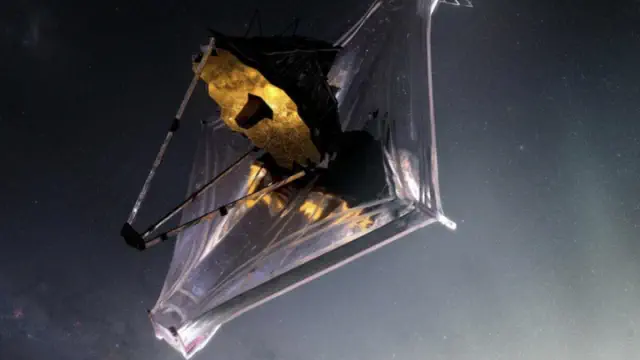
View pictures in App save up to 80% data. A depiction of the James Webb Space Telescope as it travels around the sun, located one million miles away from Earth within our solar system. Credit: SA GSFC / CIL / Adriana Manrique Gutierrez The James Webb Space Telescope might not have broken our understanding of the universe, after all. Previously, astronomers used Webb to spot curious, faint, and extremely ancient red dots that they surmised were giant galaxies. But there was a problem. It shouldn't have been possible for such massive galaxies — the earliest of which formed just some 500 to 700 million years after the universe was created — to have enough material to form copious amounts of stars and solar systems. (The universe is about 13.7 billion years old.) New insights from the powerful space observatory, orbiting 1 million miles beyond Earth, suggest the faint light of these distant "little red dots" is actually generated by active black holes at the center of the galaxies. That means the red light we see isn't coming from the glow of a prodigious number of stars. "This is how you solve the universe-breaking problem," Anthony Taylor, an astronomer at the University of Texas at Austin who co-authored the research, said in a statement. "Nasa clarified, 'In contrast to what some headlines suggest, cosmology is not in disarray,' alluding to previous media reports about the cosmic dilemma." The findings were showcased during the 245th gathering of the American Astronomical Society. Astronomers looked at a wide population of the red objects observed so far, spanning a number of different Webb surveys and elapsing hundreds of millions of years. Around 70 percent of the red objects "showed evidence for gas rapidly orbiting 2 million miles per hour (1,000 kilometers per second)," NASA explained. That's a telltale sign of a strong black hole: Black holes — which are objects wielding extreme gravitational power — amass accretion disks of super-heated, rapidly spinning dust, gas, and particles. If the scientists' findings are accurate, the illumination you observe from the red objects beneath is produced by the black holes located at the core of these ancient galaxies. View pictures in App save up to 80% data. A selection of the "little red dots" observed by the James Webb Space Telescope. Image credit: NASA / ESA / CSA / STScI / Dale Kocevski (Colby College) The tweet might have been removed. The situation, however, is not entirely resolved. Mashable Rapid Velocity Looking for more incredible stories about technology, space, and science that are truly out of this world? Subscribe to Mashable's weekly Light Speed newsletter. By clicking Sign Me Up, you confirm you are 16+ and agree to our Terms of Use and Privacy Policy. Astronomers plan to continue their exploration of the intriguing red dots. Notably, these objects start to show up in significant quantities approximately 600 million years post-Big Bang, only to see a dramatic decrease in their numbers around 900 million years later, which corresponds to 1.5 billion years after the Big Bang. What could be the reason behind this? Are they possibly being hidden from our view? Webb scientists will continue weighing their novel observations with our understanding of how the universe works. Dale Kocevski, an astronomer from Colby College in Waterville, Maine, who spearheaded the research, remarked, "There are often multiple ways to interpret the puzzling characteristics of the little red dots. It's an ongoing dialogue between theoretical models and observational data, striving to achieve a harmony between what corresponds effectively and what contradicts." The remarkable capabilities of the Webb telescope The Webb telescope — a scientific collaboration between NASA, ESA, and the Canadian Space Agency — is designed to peer into the deepest cosmos and reveal new insights about the early universe. It's also examining intriguing planets in our galaxy, along with the planets and moons in our solar system. Here's how Webb is achieving unparalleled feats, and likely will for decades to come: - Giant mirror: Webb's mirror, which captures light, is over 21 feet across. That's over two-and-a-half times larger than the Hubble Space Telescope's mirror. Capturing more light allows Webb to see more distant, ancient objects. The telescope is peering at stars and galaxies that formed over 13 billion years ago, just a few hundred million years after the Big Bang. "We're going to see the very first stars and galaxies that ever formed," Jean Creighton, an astronomer and the director of the Manfred Olson Planetarium at the University of Wisconsin–Milwaukee, told Mashable in 2021. - Infrared view: Unlike Hubble, which largely views light that's visible to us, Webb is primarily an infrared telescope, meaning it views light in the infrared spectrum. This allows us to see far more of the universe. Infrared has longer wavelengths than visible light, so the light waves more efficiently slip through cosmic clouds; the light doesn't as often collide with and get scattered by these densely packed particles. Ultimately, Webb's infrared eyesight can penetrate places Hubble can't. "It reveals the truth," Creighton remarked. - Peering into distant exoplanets: The Webb telescope carries specialized equipment called spectrographs that will revolutionize our understanding of these far-off worlds. The instruments can decipher what molecules (such as water, carbon dioxide, and methane) exist in the atmospheres of distant exoplanets — be they gas giants or smaller rocky worlds. Webb looks at exoplanets in the Milky Way galaxy. Who knows what we'll find? "We might learn things we never thought about," Mercedes López-Morales, an exoplanet researcher and astrophysicist at the Center for Astrophysics-Harvard & Smithsonian, told Mashable in 2021. Already, astronomers have successfully found intriguing chemical reactions on a planet 700 light-years away, and have started looking at one of the most anticipated places in the cosmos: the rocky, Earth-sized planets of the TRAPPIST solar system.

Read more
The Amazon River flows in a generally eastward direction, but there are instances when it appears to flow backwards. This phenomenon is primarily caused by extreme weather events, particularly heavy rainfall and flooding, which can create temporary reversals in the river's flow. Additionally, the effects of tectonic activity and sediment deposition over time can also influence the river's course. Understanding these factors helps explain the dynamic nature of one of the world's largest river systems.

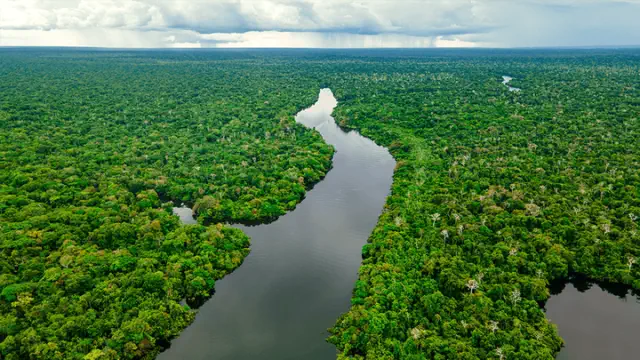
While studying river sediment flow, a geology student stumbled upon something quite strange. View pictures in App save up to 80% data. The Amazon rainforest in its current state. Photo credit: Jhampier Giron M/Shutterstock.com The Amazon River holds the title of the largest drainage system globally, both in terms of water volume and its extensive drainage basin. Spanning approximately 6,400 kilometers (or 4,000 miles), this mighty river originates in the Andes Mountains of Peru, traverses the South American continent, and ultimately discharges into the Atlantic Ocean. Interestingly, a remarkable discovery made in 2006, along with further geological research, revealed that this has not always been its course; millions of years ago, the river actually flowed in the opposite direction.  Russell Mapes, a graduate student studying geology at the University of North Carolina, was exploring the movement of river sediment from the Andes Mountains to the Atlantic Ocean when he stumbled upon a puzzling discovery. While examining sedimentary layers in central South America, he unearthed ancient zircon gemstones that appeared to originate from the east, contradicting the expected flow from the younger Andes to the west. “All along the basin, the ages of the mineral grains pointed to very specific locations in central and eastern South America," Mapes explained in a statement at the time. It's quite peculiar, considering that the Amazon is well-known for its flow from West to East rather than the reverse. So, what could have caused these ancient zircon deposits to move from East to West? This isn't the sole indication suggesting that the river might have once flowed in the opposite direction; fossils of marine creatures typically associated with seawater have also been discovered in regions where their presence seems unlikely. Looking into it further, the team determined that the Amazon river really did flow in the opposite direction in the past. That team put the reversal down to a highland area in northeastern South America, which formed during the Cretaceous Period between 65 and 145 million years ago. Drew Coleman, Mapes' supervisor, clarified, "The Amazon's landscape is so level that even a slight tilt in either direction can lead to significant changes." Researchers proposed that prior to the formation of the Andes, the existing gradient led the river to flow from East to West, directing its waters towards the Purus Arch, while the waters on the western side of the arch moved towards the Pacific Ocean. This team contended that as the highlands in the northeast underwent erosion, the flow of water shifted to the opposite direction. With the rise of the Andes, a basin emerged between the mountains and the arch. Eventually, this basin filled up and overflowed, establishing the current flow direction we observe today. Mapes noted, “We believe this recent shift occurred in the last five to ten million years, which is quite rapid in geological terms. This highlights the ephemeral nature of the Earth's surface.” While this was a reasonable hypothesis, a later model in 2014 suggested that the rise of the Andes caused them to intercept more clouds, and the subsequent flow of rain caused erosion, resulting in the Pebas wetlands. Eventually, on timescales which fit with the reversal around 10 million years ago, sediment buildup raised the area, resulting in the reversed flow of the Amazon river. Further research is expected to clarify the precise mechanism behind the reversal, but current evidence indicates that the mighty Amazon River once flowed in the opposite direction.

Read more
A newly discovered supergiant sea creature known as 'Darth Vader' has been found in the South China Sea, and it's truly enormous.

The giant isopod has been given the name Bathynomus vaderi because of its similarity to the distinctive helmet of Darth Vader from the "Star Wars" franchise. View pictures in App save up to 80% data. Bathynomus vaderi was identified when researchers observed distinct variations that set it apart from other giant isopod species. Researchers have identified a previously unknown species of giant sea bug following an examination of samples acquired from fishermen in Vietnam. Bathynomus vaderi belongs to the genus Bathynomus — giant isopods that are abundant in cold, deep waters. It is a "supergiant," weighing over 2.2 pounds (1 kilogram) and growing up to 12.8 inches (32.5 centimeters) long, making it one of the largest known isopods. The species is named "vaderi" because its head resembles Darth Vader's iconic helmet from "Star Wars." B. vaderi has so far only been found near the Spratly Islands, an archipelago in the South China Sea, but it may also live in other parts of the South China Sea, according to the study. For the new study, published Jan. 15 in the journal ZooKeys, the team examined samples caught by local fishers and found that a few specimens had distinctive physical features that marked them as a newfound species. The team described B. vaderi’s pronounced depression in its hip bone and a unique bony ridge protruding from its coracoid bone that distinguishes it from other supergiant isopods. View pictures in App save up to 80% data. In October 2024, Dr. Nguyen Thanh Son showcased a massive specimen of a different giant isopod species, B. jamesi, which was discovered in a seafood market in Hanoi. This impressive creature weighed in at 2.62 kg. The researchers noted that Bathynomus species have recently become a delicacy in Vietnam, often compared to lobster. The local demand has turned these sea bugs into an expensive staple of the live-seafood market, leading to increased fishing pressures in the region. According to the researchers, the commercial aspect presents both benefits and obstacles. While the booming market may pose risks to giant isopods, it also has the potential to lead to more stringent regulations and promote sustainable methods in deep-sea fishing. B. vaderi is not the largest isopod species. That title goes to B. jamesi, which can grow to around 20 inches (50 cm) and weigh 5.7 pounds (2.6 kg). Supergiant isopods are often found in deep-sea environments so they are challenging to study due to their inaccessibility.

Read more
Scientists are amazed by the revelation of a novel technique for decomposing plastic: 'This represents a revolutionary advancement in technology.'

View pictures in App save up to 80% data. Image Courtesy: iStock Scientists in South Korea have developed a new method of decomposing one of the world's most common types of plastic, BusinessKorea reported. The breakthrough could have major implications in plastic recycling. Polyethylene terephthalate, more commonly known as PET plastic, is one of the more ubiquitous types of plastic, used in everyday items such as plastic soda and water bottles, clothing, seatbelts, and more. It is usually made from crude oil and causes environmental harm at every stage of its production and life cycle. In order to recycle PET plastics more efficiently, scientists developed a biocatalyst (a substance that increases the rate of a chemical reaction) named KUBU-M12, which is able to break down plastic in a way that mimics how natural substances decompose. According to reports, KUBU-M12 has achieved the highest recorded performance for a biocatalyst in plastic decomposition to date. "This is a groundbreaking technology that enables permanent recycling of even contaminated plastics that cannot be recycled," said research co-lead Professor Kim Kyung-jin of the Department of Biotechnology at Kyungpook National University. While it is vital that our society moves away from traditional plastic products, instead embracing some of the many alternatives that now exist, there is still an astonishing amount of oil-derived plastic in existence, and it's not going anywhere on its own.  So, it stands to reason that we need ways to recycle this plastic efficiently instead of just letting it pile up in our landfills, in the environment, and in our oceans, where it is responsible for killing huge amounts of marine life every year. In the United States, as little as 5% of plastic waste actually gets recycled, per Beyond Plastics — whether you go through the trouble of sorting it or not. While it would still require some amount of political will to actually make it happen, enhanced recycling technologies could spur some governments to improve those numbers. View pictures in App save up to 80% data. Join our free newsletter for weekly updates on the latest innovations improving our lives and shaping our future, and don't miss this cool list of easy ways to help yourself while helping the planet. Awesome Selections

Read more
This Marine Being Possesses a Body Covered in Eyes

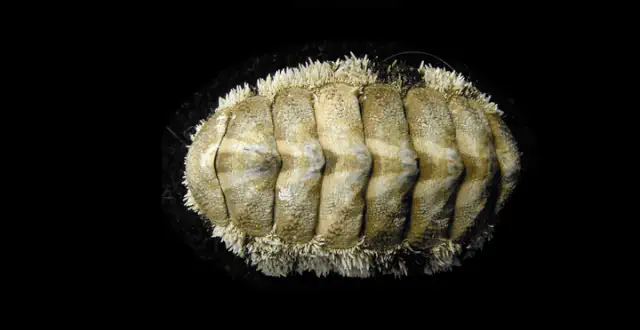
View pictures in App save up to 80% data. Chiton featuring thousands of 'eyes'. Image sourced from Science Magazine on Youtube. Chitons possess distinctive 'eyes' that set them apart from all other organisms on the planet. These small lenses, known as ocelli, enable them to perceive light and shapes. Recent research has uncovered the evolutionary pathways that led to the development of these remarkable visual systems in various existing chiton species. Chitons View pictures in App save up to 80% data. Acanthopleura granulata, commonly known as the West Indian fuzzy chiton, is a tropical species belonging to the chiton family. Image credit: PiterKrig via Depositphotos. Chitons are marine mollusks That belong to the class Polyplacophora, which contains about 940 extant and 430 fossil species. Their aragonite shell plates allow them to flex and curl up into a ball for protection. Chiton Habitat Chitons are marine mollusks that primarily inhabit rocky shorelines in intertidal zones. They are commonly found clinging to rocks and other hard surfaces, where they can withstand the harsh conditions of wave action and varying water levels. These creatures prefer areas with plenty of algae and other food sources, as they graze on these organisms using their specialized radula. Chitons are also capable of hiding in crevices and under boulders during low tide to protect themselves from predators and desiccation. Overall, their habitat is crucial for their survival, providing both nourishment and shelter. View pictures in App save up to 80% data. Acanthopleura haddoni is a tropical chiton species found in the Red Sea. This marine mollusk can often be seen clinging to rocks. Image sourced from depositphotos. Chitons are typically seen clinging to rocks while feeding on algae, bryozoans, and diatoms. Nevertheless, certain species exhibit omnivorous or carnivorous feeding habits. A Collection of Gazes View pictures in App save up to 80% data. Chiton. Photo courtesy of Deep Marine Scenes through Depositphotos. A recent research study has shown that the ancestors of chitons developed eyes on four separate occasions, leading to the evolution of two unique types of eyes that are present in chitons today. Aesthetic enthusiasts View pictures in App save up to 80% data. Acanthopleura haddoni is a tropical chiton species found in the Red Sea. This marine mollusk can often be seen clinging to rocks. Image sourced from depositphotos. Their light-detecting components, known as aesthetes, are mixed with either larger ocular structures or smaller, more abundant eyespots that link to optic nerves through openings in the shell plates. Shell Vision View pictures in App save up to 80% data. Image captured from “Marine life forms a multitude of eyes using its shell”, Source: “YouTube”, Uploaded by “Science Journal” Chiton shell eyes are situated within their aragonite shells. Each of these 'eyes' comprises a lens, pigmented cells, and photoreceptor cells located beneath the lens. While the main role of these shell eyes is to sense light, researchers also think that ocelli may be capable of recognizing simple shapes. Eye Markings View pictures in App save up to 80% data. Image captured from “Marine life forms a multitude of eyes using its shell”, Source: “YouTube”, Uploaded by “Science Journal” View pictures in App save up to 80% data. “Marine organism creates a thousand eyes from its shell”, Source: “YouTube”, Uploaded by: “Science Magazine” Chitons featuring eyespots typically possess numerous slits across their shell segments. Like shell eyes, these eye spots are composed of a lens, a layer of pigmented cells that minimize light scattering, and photoreceptor cells located beneath the lens. Their primary role is to sense light. The Evolutionary Theory View pictures in App save up to 80% data. Image captured from “Marine life forms a multitude of eyes using its shell”, Source: “YouTube”, Uploaded by “Science Journal” Evolution describes how organisms developed from earlier life forms during the earth’s history. Charles Darwin introduced the concept of evolution. The evolution of chitons, a class of marine mollusks known as Polyplacophora, is a fascinating subject that showcases the adaptability and resilience of these creatures over millions of years. Chitons are characterized by their distinctive eight overlapping shell plates, which provide protection and flexibility. Fossil evidence suggests that chitons have existed for at least 500 million years, dating back to the Cambrian period. Their evolutionary history reflects significant changes in marine environments, with chitons adapting to various habitats ranging from rocky shorelines to deep-sea ecosystems. Throughout their evolution, chitons have developed specialized feeding mechanisms, such as their radula, which allows them to scrape algae and other organic material from surfaces. Their ability to cling tightly to rocks using their muscular foot has also contributed to their survival in turbulent coastal waters. As researchers continue to study the genetic and morphological diversity of chitons, they gain insights into how these creatures have evolved in response to environmental changes and ecological pressures. Understanding chitons not only sheds light on their evolutionary journey but also provides valuable information about marine biodiversity and the health of ocean ecosystems. View pictures in App save up to 80% data. Acanthopleura haddoni is a tropical chiton species found in the Red Sea. This marine mollusk can often be seen clinging to rocks. Image sourced from depositphotos. Researchers suggest that throughout their evolutionary history, chitons have developed four distinct types of visual systems, with two still in use today. Chiton species featuring fewer slits have adapted larger and more intricate shell eyes, whereas those possessing a greater number of slits have evolved numerous but simpler eyespots on their shells. Chiton Varieties Approximately 940 species of chitons, commonly referred to as polyplacophorans, exist. These marine mollusks are distinguished by their eight-part shells and inhabit a wide range of marine habitats across the globe. Chitons primarily feed on algae, particularly those found on rocky surfaces. They use their rasping tongues, known as radulas, to scrape off the algae and other organic material from rocks and substrates in their marine environments. Some species may also consume small invertebrates or detritus. View pictures in App save up to 80% data. Acanthopleura haddoni is a tropical chiton species found in the Red Sea. This marine mollusk can often be seen clinging to rocks. Image sourced from depositphotos. Chitons are herbivorous creatures that utilize their unique radula, a tongue-like structure adorned with numerous tiny, tough teeth, to scrape algae and various organic materials from rocky surfaces. While their main diet revolves around algae, they also feed on small invertebrates and detritus, helping to maintain the cleanliness of the marine ecosystem. Yes, chitons play a significant role in their ecosystems. As herbivores, they graze on algae and other plant materials on rocky surfaces, helping to control algal growth and maintain the balance of the ecosystem. Their feeding habits can prevent overgrowth of algae, which can otherwise suffocate other marine organisms. Additionally, chitons serve as a food source for various predators, contributing to the food web. Their presence can indicate the health of their marine environment, making them important indicators of ecosystem health. View pictures in App save up to 80% data. Acanthopleura haddoni is a tropical chiton species found in the Red Sea. This marine mollusk can often be seen clinging to rocks. Image sourced from depositphotos. Certainly! Chitons are vital for the health of their ecosystems. By feeding on algae, they help control its growth, preventing it from overwhelming coral reefs and other marine organisms. Their existence is essential for sustaining the delicate equilibrium of coastal marine habitats. To observe chitons in their natural habitat, follow these steps: 1. **Research Locations**: Identify coastal areas where chitons are known to inhabit, such as rocky shorelines, tide pools, or intertidal zones. 2. **Timing**: Plan your visit during low tide, as this will expose more of the intertidal zone and increase your chances of spotting chitons. 3. **Equipment**: Bring along necessary equipment such as water shoes, a tide pool guidebook, and a camera for documentation. 4. **Look Closely**: Chitons often blend in with the rocks, so take your time to look closely at the surfaces of rocks and other substrates. They may be hiding under seaweed or in crevices. 5. **Observe Behavior**: Spend time quietly observing their behavior, as chitons can be shy. Look for movement or changes in their position. 6. **Respect the Environment**: Be mindful of the ecosystem. Avoid disturbing the rocks and surrounding marine life while observing chitons. 7. **Join a Guided Tour**: Consider joining a marine biology tour or a guided beach walk, where experts can provide insights and help you spot chitons more easily. By following these guidelines, you can enhance your chances of successfully observing chitons in their natural habitat. View pictures in App save up to 80% data. Acanthopleura haddoni is a tropical chiton species found in the Red Sea. This marine mollusk can often be seen clinging to rocks. Image sourced from depositphotos. If you want to spot chitons, visit rocky coastlines when the tide is low. Search for them attached to rocks in tide pools or nestled beneath boulders. Approach with care and kindness—these ancient and hardy animals play an essential role in their ecosystems, and it’s important to keep their environments safe and undisturbed. Summary View pictures in App save up to 80% data. Acanthopleura haddoni is a tropical chiton species found in the Red Sea. This marine mollusk can often be seen clinging to rocks. Image sourced from depositphotos. This fascinating mollusk has evolved remarkable adaptations for safeguarding itself and perceiving its surroundings. Recent research offers insights into the evolutionary history of these captivating marine creatures. Additional Updates on Animal News View pictures in App save up to 80% data. Acanthopleura haddoni is a tropical chiton species found in the Red Sea. This marine mollusk can often be seen clinging to rocks. Image sourced from depositphotos. Latest posts by Cayla de Souza, M.Sc. Ocean Sciences & Marine Biology (see all)

Read more
A recent study suggests that Earth's moon may have once possessed rings similar to those of Saturn.

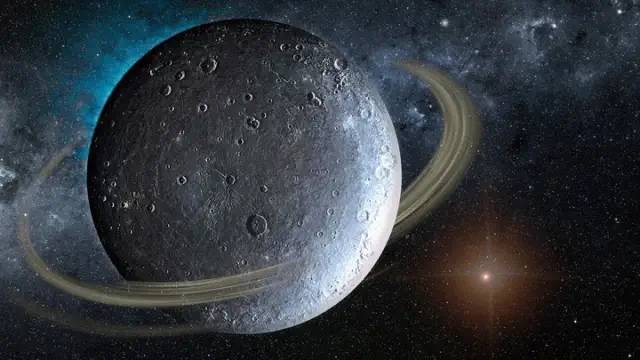
Recent research suggests that moons within our solar system might have possessed rings in the past, similar to those found around planets, raising intriguing questions about the absence of ringed moons in the present day. View pictures in App save up to 80% data. A depiction of a moon resembling Earth’s satellite, encircled by shimmering icy rings. Recent studies indicate that this scenario might have been a feasible existence for several moons within our solar system. None of the moons in our solar system possess rings today. But a new study indicates that such rings, if created, could remain stable for a million years, even while being gravitationally pulled by other solar system objects. The findings deepen the mystery of why these satellites are now ring-free. Rings surround many members of our planetary family. Saturn is perhaps the best-known example, swathed by eight main rings made of thousands of smaller ringlets, but the other three outer planets also possess rings, the Voyager space missions revealed. Composed of chunks of ice and rocks of varying sizes, these ring systems are maintained by small shepherding moons, whose gravitational forces tug the chunks and tweak their positions. More recent studies using ground-based telescopes have revealed rings encircling several centaurs — asteroids beyond Jupiter’s orbit — and minor planets, including the egg-shaped Haumea. Even Earth and Mars may once have had rings. However, no study so far has definitively spotted rings around any of the solar system's 300-odd moons. (A 2008 study claiming that Jupiter's moon Rhea possessed a ring turned out to be a false alarm.) This absence is all the more intriguing because the physical processes that create rings can theoretically occur on both planets and their satellites. A ring can form around an object when debris starts orbiting it, said Matthew Tiscareno, a planetary scientist at the SETI Institute in Mountain View, California. This debris could be kicked up from the body's surface following an asteroid or comet collision, or may consist of icy plumes ejected by powerful cryovolcanoes. Over time, gravitational forces along the body's equatorial bulge flatten out the debris into a ring, Tiscareno told Live Science in an email. But lots of moons have suffered asteroid impacts or have cryovolcanoes — and yet, they remain ringless. The search for the elusive lunar rings These observations prompted Mario Sucerquia, an astrophysicist at France's Grenoble Alpes University, and colleagues to investigate whether moon rings could be stable at all. A 2022 study Sucerquia co-authored found that theoretically, isolated moons could have stable rings around them. But that study didn't consider the gravitational effects of other moons and planets. To investigate this, in the new study published Oct. 30, 2024 in the journal Astronomy and Astrophysics. Sucerquia and colleagues selected five sets of spherical moons and their neighboring planets, including Earth and the moon. For each set, the team added rings to all the satellites, then simulated how the rings would behave over a million years, while being pulled gravitationally by their parent moon, other nearby moons and the planet. The researchers also calculated how chaotically the ring particles moved over a millennium, to determine the rings' stability. The researchers expected to find that the rings were unstable, but the model showed that, barring a few moons, including Saturn's "Death Star" moon Mimas, these moon rings were stable — particularly Jupiter’s Iapetus. Even Earth's moon had a 95% chance of supporting a stable ring system in the simulations. Sucerquia shared with Live Science via email, "[W]e were not expecting that moons situated in a challenging gravitational setting, influenced by numerous other moons and planets, would be able to preserve stability in their rings." He added, however, that "instead of obliterating the rings, these harsh environments have enhanced their beauty by forming intricate structures such as gaps and waves, akin to what we see in Saturn's rings." View pictures in App save up to 80% data. Currently, none of the 293 moons in our solar system, as illustrated in this image, possess permanent rings. What happened to all the rings? So why don't the moons have rings today? The authors suggest that non-gravitational factors, including the sun's radiation and charged particles from the magnetic fields of the moons' parent planets, caused any previous rings to disintegrate. There are differing opinions regarding the conclusions of the study. Tiscareno, who did not participate in the research, believes that over time, the rings were probably disrupted by the gravitational forces exerted by the moons that orbit the planet. "Because most solar system moons rotate very slowly (keeping the same face towards their planet as they orbit, as our moon does to Earth), any ring particles must be orbiting the moon much faster than the moon spins," he said. So gravitational tugs from the parent moons, over long stretches of time, would "cause the ring particle orbits to decay until they eventually impact the surface of the moon," he said. In other words, if our moon ever had rings, they crashed to the lunar surface long ago.

Read more
Certain Areas of Idaho Are Expected to Experience Arctic-Like Conditions Next Week

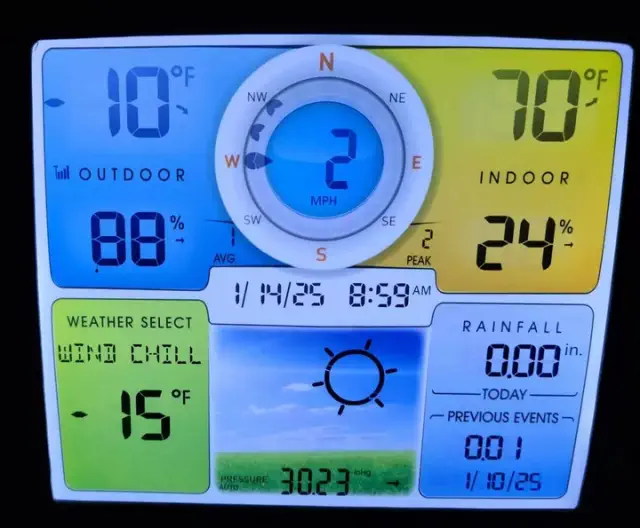
View pictures in App save up to 80% data. Utilized with the consent of Mike McFadyen. I thought the upper teens were cold in the Magic Valley.  I watched this morning as the Twin Falls thermometer bottomed out at 17 degrees.  Rough, yes, but in some parts of Idaho, they would’ve gladly traded places. Mike McFadyen owns a ranch near Fairfield.  Camas County is a bit higher (sometimes by a lot) above sea level.  His temperature settled in at 10 below zero at one point Tuesday morning.  By next Tuesday, it’s likely to be even colder at Mike’s ranch.  And we’ll still be better off than much of the nation.  By Inauguration Day, temperatures in the eastern two-thirds of the lower 48 are expected to be 20 degrees below average. For anyone from Idaho planning to be in Washington for Inauguration Day, expect cold and snowy weather.  There have been some historically cold precedents. The pattern is a continuation of what we’ve been seeing in recent weeks across the continent.  A friend lives near St. Petersburg, Florida.  She woke to a low of 36 degrees on Sunday morning.  That’s rough for people there, but a lot like one of our January daytime highs.  Just remember that the heat and moisture make that state almost unbearable in summer.  It may get hotter here in summer, but the dew point is low. I keep thinking that if we can get through another couple of weeks we’ll be in the clear, but my hopes have been dashed in the past.  A guy I worked with had grown up in Buhl.  He described the weather in southern Idaho as winter until one day in late spring when you suddenly switch to 100-degree highs every day.  Like someone flipped a switch.

Read more
Stone Age Craftspeople Selected Their Materials Deliberately. A Recent Study Aims to Uncover the Reasons Behind Their Choices.

To effectively engage with the simplest forms of technology, one needs to possess a certain level of intelligence. View pictures in App save up to 80% data. Ancient quartzite spearheads, akin to the tools examined in the research. However, which option would a Stone Age artisan opt for? Image credit: Ique Perez/Shutterstock.com The human Stone Age was, undeniably, the first step on a journey towards the species total technological dominance – but it didn’t have to be. After all, pick a rock that’s too soft, or too wonky, and our ancestors may never have made it past “ape with aspirations”. So how did they manage to get it so right? Recent research offers insights into this question, or at the very least, lays the groundwork for further exploration. By conducting direct experiments on different raw materials sourced from percussive tools at Melka Wakena, an archaeological site in the Ethiopian Highlands dating back 1.6 to 0.7 million years, scientists were able to deduce the qualities that rendered these materials beneficial to our prehistoric ancestors. They also examined the circumstances under which specific advantages were prioritized over others in their decision-making processes. “Our research shows that the material properties of the stones – such as suitability, quality, and durability – were likely crucial factors in the selection process by early hominins,” explained Dr Eduardo Paixão, a researcher at the University of Algarve, Portugal, and study lead, in a translated statement. Paixão remarked, “This indicates that they possessed a profound awareness of their surroundings and made intentional decisions.” It wasn’t always as straightforward as you might think, either. For as primitive as we like to think of our Stone Age ancestors being, they understood the nuances of rock way better than we do (save for the odd geologist out there): “Our experimental results show that, while two types of rock (ignimbrite and glassy ignimbrite) appear similar to the naked eye, they behave considerably differently,” explains the paper. The study highlights that glassy ignimbrite, sourced from a greater distance, posed some challenges in terms of convenience for use. However, it was noted to be “considerably tougher” and “the most uniform raw material available, exhibiting superior resistance.” Consequently, the softer variant of the rock, though more accessible, was overlooked in favor of “glassy ignimbrite, which was transported from afar as substantial flake blanks, specifically chosen for creating [large cutting tools].” It’s not just the results that are important here. As the paper makes clear, a lot of what we’ve traditionally understood about Stone Age technology has been based on… well, vibes, more or less: “in many cases, […] inferences about [artefacts’] specific functions are based on preconceived assumptions about their size and morphology,” the paper explains.  Even those that have been systematically analyzed are still kind of fuzzy, it adds, since “Differences in the physical properties of rocks are often described and organized by researchers in distinct categories of ‘raw material quality’. "It clarifies that, nonetheless, establishing and measuring this 'quality' is quite complex." In that respect, the new paper – and the project it marks a beginning to – is undoubtedly remarkable. It’s perhaps the first study to analyze these ancient stone tools on their own terms: not only performing a post-hoc analysis of the artefacts, but replicating their original use. And it’s paid off: already, the researchers have noticed that some properties, previously assumed to be one of these mysterious “qualities” of the rock itself, are actually the result of the tool’s use over time. Co-author Dr. João Marreiros stated, “The intentional choice of materials impacted the alterations observed on the tools' surfaces. This indicates that variations in archaeological discoveries are not merely coincidental.” “These discoveries provide fresh insights into the technological advancements of early human civilizations,” remarked Paixão. “We intend to conduct additional studies to gain a deeper understanding of the intricate choices made by these primitive artisans.” The study is published in the journal PLOS ONE. 

Read more
Introducing the Most Primitive Organism on Earth

View pictures in App save up to 80% data. To keep things concise and straightforward, I’ll assume that anyone reading this is familiar with the fundamentals of evolution. If you happen to be reading this from a confined bathroom on your parents’ community laptop, part of an evangelical group, I apologize. I’m not equipped to be your guide to contemporary science. For everyone else, it’s clear that the majority of life forms on our planet have evolved into their current states through extensive adaptation, developing features such as opposable thumbs, gills, or even poison-filled sacs.  You might be curious if there exists a creature that got it right on the first attempt—a flawless example that possessed all it required from the instant it came into being. Which organism on our planet has undergone the least transformation throughout the ages? Well, I have the answer for you, but it’s probably not as exciting as you were hoping for (I’ll also note that I’m not including microorganisms because the answer being “bacteria,” well, that’s no fun at all).  If I had to place my bets, I’d put my money on the horseshoe crab. It seems like these strange little creatures are destined to be the first to make contact with extraterrestrial beings. Alternatively, one might wish for a formidable apex predator, one that has never faced defeat and comes armed with natural spines and sharp edges from the very beginning.  The response is not related to either of those options. It's somewhat expected, in a peculiar way, that the apparent victor is simply a soggy collection of cells: the sponge. View pictures in App save up to 80% data. Shutterstock Not only have they been well-equipped to handle pretty much the entirety of life on Earth, sponges are also the oldest animal on earth, the first to emerge from life's single common ancestor: a phylum. Since roughly 640 million years ago, sponges have been perfectly content to float around and filter-feed on bacteria, and that lifestyle has never needed a drastic change. Of course they've branched off, and there’s many more species than there used to be, but that number still tops out at about 5,000.  In other words, SpongeBob SquarePants might trace his lineage all the way back to the very first multi-cellular organisms on Earth.

Read more
'Abundant venom levels!' Alert raised as a newly identified 'big boy' funnel-web spider capable of causing death within 15 minutes is found.

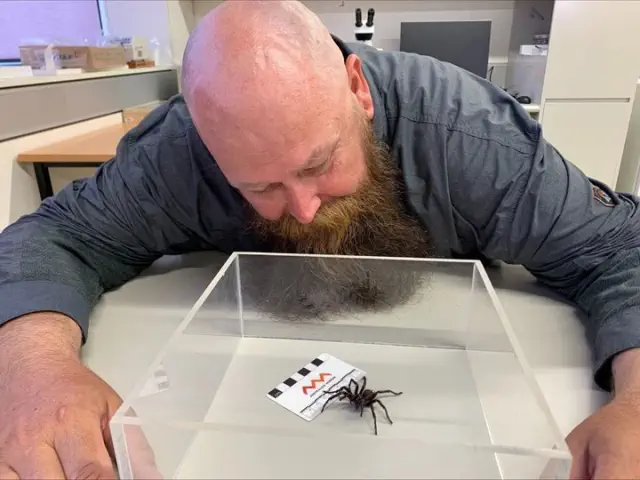
Atrax christenseni has officially been recognized as one of the most venomous spider species in the world. Australian scientists have discovered a new species of funnel-web spider that is almost double the size of its nearest relative and has the ability to inject "large quantities of venom." Dubbed the 'Big Boy', the deadly arachnid can grow up to 9cm in length and possesses longer fangs than the common Sydney funnel-web spider. The recently identified species, known as Atrax christenseni, was found in the vicinity of Newcastle, approximately 170 kilometers north of Sydney, and has been recognized as one of the most venomous spiders in the world. Researchers indicate that its more substantial venom glands and elongated fangs might be capable of piercing through protective gloves, and similar to its relative from Sydney, it can be lethal within 15 minutes if antivenom is not administered. View pictures in App save up to 80% data. Arachnologist Kane Christensen first encountered the spider in 2018. In 2018, spider specialist Kane Christensen made his initial discovery of these extraordinary arachnids while employed at the Australian Reptile Park. Upon informing the Australian Museum in Sydney, researchers verified that it was a previously undiscovered species, which they subsequently named to honor Christensen. "It's hard to believe. Having a spider that I'm deeply passionate about named in my honor feels like a dream realized. It's truly thrilling," Christensen shared with 9News. The spider can reach a body length of up to 4.5cm and possesses venom glands that are considerably larger than those of typical funnel-web spiders in Sydney. Christensen remarked, "The size of this male specimen is simply... astonishing." RECENT UPDATES View pictures in App save up to 80% data. Specialists indicated that the spider might be spotted roaming around a garage or bedroom. After conducting thorough DNA analysis, researchers have validated the existence of three separate species of funnel-web spiders in the area. In addition to the recently uncovered Newcastle funnel-web, scientists have also recognized the 'traditional' Sydney funnel-web (Atrax robustus) and the Southern Sydney funnel-web (Atrax montanus). The Newcastle species has been located within a 25km radius of the Newcastle region and is not expected to migrate southward to Sydney. Professor Kristofer Helgen, head of the Australian Museum Research Institute, described it as "a remarkable milestone in the study of spider biology." DNA analysis has shown that the Newcastle funnel-web spider and the Sydney species diverged from a common ancestor approximately 17 million years ago. Although this spider possesses a highly toxic venom, specialists have verified that the current antivenom is still effective against this newly identified species. View pictures in App save up to 80% data. Kane Christensen referred to the finding as 'incredible.' Since the development of antivenom in the 1980s, there have been no recorded fatalities from funnel-web spider bites in Australia. Nonetheless, Christensen cautioned those who find themselves in close proximity to the spider. "I definitely wouldn't advise getting close to them; the amount of venom they produce is significant," he cautioned. Professor Geoff Isbister, who heads the Clinical Toxicology department at Calvary Mater Hospital in Newcastle, pointed out that the spider's increased size might result in a higher quantity of venom with each bite. He added that the antivenom is "extremely effective if administered promptly, ideally within one to two hours following the bite." Newcastle funnel-web spiders typically reside in garages, bedrooms, and various parts of homes, often entering during the night. The male spiders are especially active from November to April, as they venture out after dark in search of potential mates.

Read more
A prominent nose, striking blue eyes, and golden hair: The visage of King D. Dinis unveiled 700 years posthumously.

View pictures in App save up to 80% data. Seven hundred years after his passing, the visage of King D. Dinis, Portugal's sixth monarch, was unveiled following comprehensive 3D facial reconstruction efforts. This facial analysis was conducted at the FaceLab of Liverpool John Moores University, with scientific oversight provided by anthropologist Eugénia Cunha from the University of Coimbra. The initiative commenced in 2016 with efforts to restore the tomb of D. Dinis. Nevertheless, it wasn't until 2023 that the crucial decision to open the tomb and conduct DNA analysis was made. D. Dinis’s face, at the time of his death, revealed an elderly man  64 years of age. Eugénia Cunha explains, "The findings we have were based on robust scientific data derived from a remarkably well-preserved skeleton that retains all of its facial bones." Cunha further describes the king as having “an elongated nose” and “a chin that is somewhat receding,” along with “blue eyes” that might have a hint of green blended in. D. Dinis would have stood  “between 1.65 and 1.68 meters” the scientist also reveals, noting that she had a “population affinity 71% European”. Miss Cunha noted that “he had all of his teeth at the time of death, with only one cavity,” highlighting that he was “an adult with remarkable resilience” and “quite sturdy.” "While some individuals did live to advanced ages, being 63 years old 700 years ago would be akin to being 90 or older in today's context," the scientist elaborates, adding that such longevity would likely be attributed to "proper nutrition" and their status within "an elite group." "Historical accounts suggest that the king was likely bedridden prior to his death, which could explain why he appeared gaunter in the face," she observes. Eugénia Cunha also disclosed that this marks “the first portrait of a Portuguese king to be scientifically validated.” “The appearance of this face is backed by scientific evidence. It wasn't the creativity of an artist that shaped the image of D. Dinis; rather, it was his skull and genetic makeup that revealed his true likeness,” emphasizes the anthropologist. The scientist further clarified that DNA analysis was conducted using the root of a tooth. “Afterward, we replaced the crown. We only compromised the root,” she emphasized, noting that they were not “damaging a femur or extracting teeth.” D. Dinis was responsible for one of the longest reigns in Portugal’s history  between the years 1279 and 1325. He was also known as the Farmer or Poet-King. His likeness will be unveiled to the nation in a touring exhibition set to launch in April 2025.

Read more
Archaeologists recover a 2,600-year-old shipwreck near the shores of Spain | Global | Headlines

View pictures in App save up to 80% data. After more than three decades since its initial discovery, archaeologists have unearthed a shipwreck off the coast of Spain that dates back 2,600 years. The Mazarrón II went down around 600 B.C.E and was quickly covered by sand, which played a significant role in preserving it out of sight for many centuries. In a remarkable achievement, researchers successfully brought the shipwreck back to the surface from its underwater resting place between September and November 2024. While conducting the extraction, researchers uncovered new materials such as pieces of rope and ceramic fragments. The preservation of these fragile items offers a rare chance for advancement in archaeological studies. Step by step, a group of 14 experts, directed by Carlos de Juan from the University of Valencia, meticulously moved the Phoenician ship onto dry land for further study and preservation. Now, those fragments are going to a lab at the Museum of Underwater Archaeology in Cartagena for conservation and reconstruction.  Scientists are optimistic that the remains will provide fresh insights into the Phoenician civilization. Carlos de Juan, the director of the excavation project, told El Cronista: “It has been delicate work, but mechanical. Slow, but equivalent to what the team had already done before in other scenarios of extracting archaeological remains. "The vessel now resembles a cake in texture: it remains stable when horizontal but falls apart with even a slight tilt." Divers initially located The Mazarrón II in 1994 in the waters of Murcia, Spain’s Ministry of Culture revealed. It was one of two wrecks found near the town of Mazarrón, which they have both been named after. The vessel has a length of 8.10 meters and a maximum width of 2.25 meters. The wreck had been covered by a protective metal box, however, a group of experts found that the metal box was sinking and threatened to crush the shipwreck. In the summer of 2023, archaeologists devised a strategy to recover the shipwreck from the ocean floor. They dedicated 560 hours to diving at the site, meticulously creating detailed diagrams of the ship's numerous fractures. Currently, the team is focused on rehabilitating the artifacts and safeguarding them within the National Museum of Underwater Archeology. The University of Valencia stated: “This dedicated center will carry on the efforts of restoration and research, guaranteeing the conservation and examination of this invaluable historical accomplishment.”

Read more
Unveiling the Remarkable Strength of Celtic Women and Their Daughters

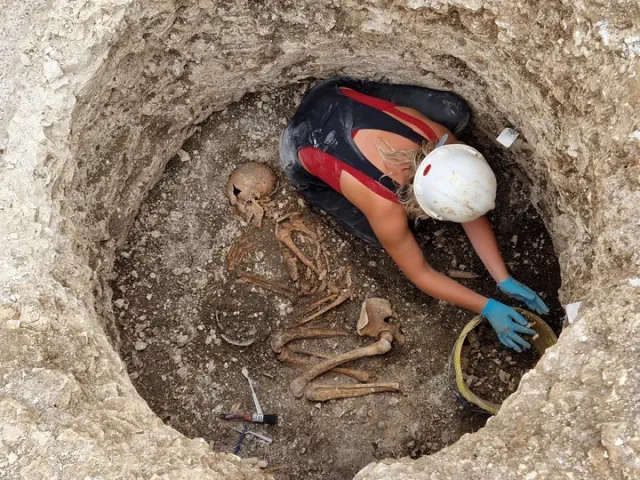
Bournemouth University View pictures in App save up to 80% data. Numerous female skeletons were discovered interred alongside precious items such as pottery. New research suggests that women in Britain 2,000 years ago may have transferred land and wealth to their daughters rather than their sons, indicating that communities were organized around maternal lineage. Skeletons discovered in Dorset revealed DNA evidence indicating that Celtic men relocated to reside with the families and communities of their wives. Researchers discovered indications of an entire community that developed over generations centered on the female lineage of a family, likely tracing back to a single woman. "According to Dr. Lara Cassidy, the lead author of the study from Trinity College Dublin, this suggests that during the Iron Age in Britain, women held significant power and were capable of influencing the society's direction in various aspects." Bournemouth University View pictures in App save up to 80% data. The archaeologists were thrilled to discover skeletons remarkably well-preserved in the clay soil of Dorset. This marks the first documented instance of communities forming around women in ancient European history. Researchers suggest that the communities likely devoted significant resources to their daughters, anticipating that they would inherit their mothers' social standing. Dr. Cassidy remarks, "While it's quite uncommon in today's societies, this may not have always been true." The team discovered indications that it occurred in various locations across Britain, implying that it was prevalent. The communities examined thrived during the era of Boudica, the warrior queen who spearheaded a revolt against Roman forces in East Anglia circa AD 61. Dr. Cassidy analyzed the DNA extracted from the skeletal remains of 57 members of a tribe known as the Durotriges. This group inhabited Winterborne Kingston in Dorset during the period spanning from 100 BC to AD 100. A team of archaeologists from Bournemouth University excavated the skeletons from a burial site. Through the analysis of mitochondrial DNA, which is inherited exclusively from mothers, Dr. Cassidy discovered that the majority of women in the community share a familial connection that stretches back several generations. In contrast, the Y chromosomes exhibited significant diversity, which is inherited from father to son, suggesting that men from various families integrated into the community through marriage. Bournemouth University View pictures in App save up to 80% data. The remains of individuals from the Durotriges tribe were remarkably well-preserved. The DNA examination suggests that the majority of the ancestral lineage can be traced back to one particular woman. The findings suggest that this society operated under a matrilocal structure, where a husband would relocate to reside within his wife's community. Dr. Cassidy states, "One of the most apparent advantages for a woman is that by staying at home, she maintains her support network. Her parents, siblings, and family members remain close by." "Your husband is the one entering the picture; he is the unfamiliar face in the community and relies on your family for his support and land," she continues. The researchers discovered similar evidence of matrilocality in skeletal remains from additional burial sites, including those located in Cornwall and Yorkshire. She argues that instances of influential women in ancient societies have frequently been overlooked as isolated cases rather than the standard, but these discoveries call that perspective into question. Archaeologists Professor Miles Russell and Professor Martin Smith discovered additional proof indicating that women held a significant status. Bournemouth University View pictures in App save up to 80% data. Researchers from Trinity College and Bournemouth conducted excavations and analyses on the remains of 57 individuals. "We find quite elaborately furnished graves with high status objects of wealth. Every time we find that, it occurs in women's graves, so we think wealth was being transferred down the female line," says Prof Martin Smith at Bournemouth University. The results also support ancient Roman texts that indicated women in Britain held considerable power, arguably even greater than that of their counterparts in Rome. However, Romans such as Julius Caesar considered that to be a mark of primitiveness. "According to Professor Miles Russell from Bournemouth University, 'Women in Britain held significant power, contributing to a more egalitarian society. This was a major issue for the Romans, who lived in a highly patriarchal culture. To the Romans, this characteristic made the Britons appear as the epitome of barbarism.'" Most societies today follow a patrilocal structure, where women relocate to the communities of their husbands. However, certain matrilocal communities can still be found today or have existed in the recent past, such as the Akans in Ghana, West Africa, and the Cherokee in North America. Researchers suggest that Iron Age Britain might have been matrilocal, as men were often absent due to warfare. Dr. Cassidy likens it to World War II, a time when women experienced an increase in their political and economic influence. According to her, matrilocal societies tend to have a lower likelihood of facing internal conflicts. "It has the potential to foster a sense of togetherness among nearby communities and villages. By separating clusters of related males, it prevents the formation of deep bonds and the onset of conflicts with neighboring related males," she proposes. The results have been released in the scientific publication Nature. Follow Georgina on Blue Sky.

Read more
Located 12 billion light-years away from our planet, NASA has identified a colossal reservoir of water that holds 140 trillion times the volume of water found on Earth.

View pictures in App save up to 80% data. In a groundbreaking discovery, NASA astronomers have unveiled an immense reservoir of water vapor surrounding a distant quasar. This cosmic oasis, located a staggering 12 billion light-years from Earth, contains an astounding 140 trillion times more water than all of our planet’s oceans combined. The finding not only reshapes our understanding of the early universe but also raises intriguing questions about the prevalence of water in cosmic structures. Revealing the celestial oceanic realm The colossal water reservoir was detected in 2011, enveloping a quasar known as APM 08279+5255. This celestial powerhouse dates back to when the universe was merely 1.6 billion years old, offering a rare glimpse into the cosmos’ infancy. The sheer magnitude of water present in this ancient system challenges our perceptions of elemental distribution in the early universe. Quasars, among the most luminous objects in the universe, are fueled by supermassive black holes. In the case of APM 08279+5255, the central black hole is a behemoth, 20 billion times more massive than our Sun. This cosmic engine generates energy equivalent to a thousand trillion suns, creating a unique environment where water vapor extends across hundreds of light-years. The discovery of this vast water reservoir aligns with recent advancements in our understanding of cosmic phenomena. For instance, a seemingly trivial flicker of light recently revealed the source of a mysterious cosmic phenomenon, highlighting how seemingly minor observations can lead to major breakthroughs in astrophysics. Matt Bradford, a researcher at Nasa’s Jet Propulsion Laboratory, highlights the uniqueness of this environment in a study published in the journal Astrophysical Journal Letters: “The environment around this quasar is truly unique in its ability to produce this enormous mass of water”. This discovery confirms the prevalence of water in the universe, even in the most remote epochs. Features of the interstellar oasis The water vapor enveloping APM 08279+5255 displays remarkable traits that distinguish it from conventional galactic settings. These distinctive features arise from the powerful infrared and X-ray radiation produced by the quasar. Below is an overview of its extraordinary properties: Temperature: Approximately -63°C, five times warmer than average galactic conditions Density: 10 to 100 times higher than similar cosmic environments Extent: Envelops the quasar across hundreds of light-years The conditions of this cosmic oceanic realm are strikingly dissimilar to those found in our nearby galaxy. The intense environment generated by the quasar's radiation promotes the condensation of water to an extraordinary degree, providing a one-of-a-kind setting for examining the properties of matter in extreme conditions. While this discovery is monumental, it’s worth noting that advancements in space exploration continue to push boundaries in other areas as well. For example, China recently unveiled a hypersonic aircraft capable of circumnavigating Earth in just 2 hours, showcasing how our understanding of both cosmic and terrestrial frontiers continues to expand rapidly. Consequences for the development of the universe and the emergence of life The discovery of this massive water reservoir has profound implications for our understanding of cosmic evolution and the potential for life in the universe. NASA scientist Matt Bradford emphasizes that this finding proves water was already abundant in the very early universe, challenging previous assumptions about elemental distribution in cosmic history. This discovery illuminates the processes involved in the formation and evolution of galaxies, especially in extreme conditions. It indicates that the essential components for life, as we understand it, might have existed much earlier in the history of the universe than was previously believed. Investigating these water-abundant environments could yield vital information about the prerequisites for life to arise in the universe. Aspect Significance Water abundance Indicates potential for life-supporting environments Early universe composition Challenges theories of elemental distribution Galaxy evolution Provides insights into formation processes As we continue to explore the cosmos, discoveries like this remind us of the vast mysteries that still await us. From the depths of space to innovations closer to home, such as the most efficient and economical heating systems, science constantly pushes the boundaries of our knowledge. Prospective studies and investigations The identification of water vapor surrounding APM 08279+5255 was achieved using millimeter and submillimeter observations, which enable researchers to explore far-off and intricate settings. This significant advancement opens up new avenues for research, especially with the development of cutting-edge instruments such as the CCAT telescope, which is being built in the Atacama Desert of Chile. Astronomers are optimistic that these advanced instruments will lead to the identification of additional water sources in the early universe, as well as enhance the exploration of primordial galaxies. Such initiatives have the potential to transform our comprehension of the essential conditions for life and the core mechanisms that influence the formation of cosmic structures. As we delve deeper into the cosmos, it’s fascinating to consider how discoveries in space can influence our daily lives. For instance, certain winter drinks have been found to stimulate concentration and memory, showcasing how research in various fields can intersect to improve our understanding of both the universe and ourselves. To sum up, the identification of this enormous water reservoir located 12 billion light-years from us represents a remarkable achievement in our exploration of the universe. This finding not only enhances our understanding of the primordial cosmos but also prompts fascinating inquiries regarding the existence of water and the possibilities for life beyond our planet. As we delve deeper into the enigmas of the universe, we are reminded that the fundamental elements necessary for life as we recognize it are more widespread and ancient than we previously thought.

Read more
This Facebook Page Shares Hilarious Science Memes: Check Out These 105 Gems!

View pictures in App save up to 80% data. The internet has done a lot of things, not least it’s proven that if something exists, it can be made into a meme. After all, if something exists, it can be perceived, and that comes with a whole host of relatable and often pretty funny observations. The “Science Funnies Page” FB page is dedicated to hilarious memes and posts that are as funny as they are, sometimes, educational. So get comfortable as you scroll through, upvote your favorites and be sure to share your thoughts in the comments below. More info: Facebook This post may include affiliate links. #1 View pictures in App save up to 80% data. #2 View pictures in App save up to 80% data. #3 View pictures in App save up to 80% data. #4 View pictures in App save up to 80% data. #5 View pictures in App save up to 80% data. #6 View pictures in App save up to 80% data. #7 View pictures in App save up to 80% data. #8 View pictures in App save up to 80% data. #9 View pictures in App save up to 80% data. #10 View pictures in App save up to 80% data. #11 View pictures in App save up to 80% data. #12 View pictures in App save up to 80% data. #13 View pictures in App save up to 80% data. #14 View pictures in App save up to 80% data. #15 View pictures in App save up to 80% data. #16 View pictures in App save up to 80% data. #17 View pictures in App save up to 80% data. #18 View pictures in App save up to 80% data. #19 View pictures in App save up to 80% data. #20 View pictures in App save up to 80% data. #21 View pictures in App save up to 80% data. #22 View pictures in App save up to 80% data. #23 View pictures in App save up to 80% data. #24 View pictures in App save up to 80% data. #25 View pictures in App save up to 80% data. #26 View pictures in App save up to 80% data. #27 View pictures in App save up to 80% data. #28 View pictures in App save up to 80% data. #29 View pictures in App save up to 80% data. #30 View pictures in App save up to 80% data. #31 View pictures in App save up to 80% data. #32 View pictures in App save up to 80% data. #33 View pictures in App save up to 80% data. #34 View pictures in App save up to 80% data. #35 View pictures in App save up to 80% data. #36 View pictures in App save up to 80% data. #37 View pictures in App save up to 80% data. #38 View pictures in App save up to 80% data. #39 View pictures in App save up to 80% data. #40 View pictures in App save up to 80% data. #41 View pictures in App save up to 80% data. #42 View pictures in App save up to 80% data. #43 View pictures in App save up to 80% data. #44 View pictures in App save up to 80% data. #45 View pictures in App save up to 80% data. #46 View pictures in App save up to 80% data. #47 View pictures in App save up to 80% data. #48 View pictures in App save up to 80% data. #49 View pictures in App save up to 80% data. #50 View pictures in App save up to 80% data. #51 View pictures in App save up to 80% data. #52 View pictures in App save up to 80% data. #53 View pictures in App save up to 80% data. #54 View pictures in App save up to 80% data. #55 View pictures in App save up to 80% data. #56 View pictures in App save up to 80% data. #57 View pictures in App save up to 80% data. #58 View pictures in App save up to 80% data. #59 View pictures in App save up to 80% data. #60 View pictures in App save up to 80% data. #61 View pictures in App save up to 80% data. #62 View pictures in App save up to 80% data. #63 View pictures in App save up to 80% data. #64 View pictures in App save up to 80% data. #65 View pictures in App save up to 80% data. #66 View pictures in App save up to 80% data. #67 View pictures in App save up to 80% data. #68 View pictures in App save up to 80% data. #69 View pictures in App save up to 80% data. #70 View pictures in App save up to 80% data. #71 View pictures in App save up to 80% data. #72 View pictures in App save up to 80% data. #73 View pictures in App save up to 80% data. #74 View pictures in App save up to 80% data. #75 View pictures in App save up to 80% data. #76 View pictures in App save up to 80% data. #77 View pictures in App save up to 80% data. #78 View pictures in App save up to 80% data. #79 View pictures in App save up to 80% data. #80 View pictures in App save up to 80% data. #81 View pictures in App save up to 80% data. #82 View pictures in App save up to 80% data. #83 View pictures in App save up to 80% data. #84 View pictures in App save up to 80% data. #85 View pictures in App save up to 80% data. #86 View pictures in App save up to 80% data. #87 View pictures in App save up to 80% data. #88 View pictures in App save up to 80% data. #89 View pictures in App save up to 80% data. #90 View pictures in App save up to 80% data. #91 View pictures in App save up to 80% data. #92 View pictures in App save up to 80% data. #93 View pictures in App save up to 80% data. #94 View pictures in App save up to 80% data. #95 View pictures in App save up to 80% data. #96 View pictures in App save up to 80% data. #97 View pictures in App save up to 80% data. #98 View pictures in App save up to 80% data. #99 View pictures in App save up to 80% data. #100 View pictures in App save up to 80% data. #101 View pictures in App save up to 80% data. #102 View pictures in App save up to 80% data. #103 View pictures in App save up to 80% data. #104 View pictures in App save up to 80% data. #105 View pictures in App save up to 80% data.

Read more
90 Instances Where People Had To Double-Take To Comprehend What They Were Seeing (Fresh Photos)

When you look up at the sky full of fluffy clouds, what do you see? An elephant holding a balloon? Or perhaps a dragon spewing fire? This is nothing strange, as our brains are programmed to recognize familiar patterns and shapes in what we see. The phenomenon, called pareidolia, helps us make sense of the world and avoid danger.Bored Panda gathered many more similar examples where people saw things as other things, assigning meaning when there might not be one. Scroll down to find them, and be sure to upvote the ones that mess with your eyes and brains the most! This post may include affiliate links. #1 Southern Los Angeles Resembles a Computer Motherboard View pictures in App save up to 80% data. #2 This Buff-Tip Moth Camouflaged as Birch Bark View pictures in App save up to 80% data. #3 My Cat Resembles a Lemur View pictures in App save up to 80% data. More technically, pareidolia is “the illusory perception of meaningful patterns or images of familiar things in random or amorphous data, as a face seen on the moon.” Despite being a universal human trait, the phenomenon remains largely enigmatic. Neuroscientists have gained insights into the brain regions involved, and they believe it is an evolutionary advantage that helped our ancestors recognize faces and detect potential dangers in their environment. #4 Refilling the Soap Dispenser Led to Overnight Growth of Fungal Shapes View pictures in App save up to 80% data. #5 I transformed a burned match into a microphone complete with a stand. View pictures in App save up to 80% data. #6 My Hair Resembles Something That Got Stuck in a Zipper/ Gets Caught in Machinery Gears View pictures in App save up to 80% data. Most commonly, people spot faces and animals in inanimate objects. Our hypersensitivity to detecting faces even has its own category of pareidolia—face pareidolia. In a sense, it can be considered a side effect of our ability to quickly identify human features. This efficiency in detecting faces can sometimes make us see them when they aren’t there. #7 This piece of pine wood features an arrow indicating the location of the tree's center. View pictures in App save up to 80% data. #8 My Dog Has a Star-Shaped Eye View pictures in App save up to 80% data. #9 The base of my iris features a shape and texture reminiscent of a feather. View pictures in App save up to 80% data. Curiously, the phenomenon of recognizing shapes on the moon's surface falls under a unique classification known as lunar pareidolia. Observers frequently interpret the contrasting light and shadow on the moon as recognizable figures. For instance, in certain European nations, individuals perceive a ‘banished man’ with a load of sticks, whereas in various Asian cultures, they envision a rabbit. #10 Discovered These Corroded Pliers Outside, They Appear to Be Made of Wood View pictures in App save up to 80% data. #11 My Pancake Resembled a Brain View pictures in App save up to 80% data. #12 This Mushroom Resembling a Glove Emerging from My Planter View pictures in App save up to 80% data. Hermann Rorschach was also inspired by people’s ability to see meaning where there isn’t. His Rorschach inkblot test, where people are influenced or guided by specialists to see things in ink splotches that reveal their unconscious thoughts, is an example of directed pareidolia. This test is still used in practice by some psychologists to diagnose schizophrenia. #13 This Spoiled Melon Resembles a Color Vision Test View pictures in App save up to 80% data. #14 This Blossom Resembles Frosting View pictures in App save up to 80% data. #15 My Mayo Resembles the Sorting Hat from Harry Potter View pictures in App save up to 80% data. Although there are numerous visual instances, pareidolia extends beyond just sight and can manifest in auditory perceptions as well. This phenomenon happens when we mistakenly interpret sounds like bird calls, static noise, or flowing water as if they were human voices. Additionally, we might misinterpret song lyrics or hear nonexistent words. #16 I Accidentally Spilled Diet Coke Beneath My Desk at Work, and the Bubbles Created a Lowercase E. View pictures in App save up to 80% data. #17 A Seastar Regenerating Four Arms Resembles a Shooting Star View pictures in App save up to 80% data. #18 Created a pancake that unexpectedly resembles an apple. View pictures in App save up to 80% data. In general, pareidolia is a specific form of apophenia, a wider concept that refers to the tendency to perceive patterns or significance in random information. This inclination is a fundamental aspect of human nature, as we seek to establish connections in a world that often appears disorganized and chaotic. However, when this tendency becomes excessive, it may indicate underlying mental health issues such as bipolar disorder, major depression, or schizophrenia, which can cause individuals to disconnect from reality. #19 Discovered an Awesome Stick That Resembles a Great Wizard's Staff. View pictures in App save up to 80% data. #20 This carrot resembles the S shapes we all used to doodle back in middle school. View pictures in App save up to 80% data. #21 The Blanket I Was Cleaning Emerged From The Washer Resembling A Muffin View pictures in App save up to 80% data. At the same time, experts see a positive side to apophenia and pareidolia. “We think pareidolia may enhance focus, creativity, and innovation because you’re seeing things in a different way. If this turns out to be the case, building pareidolia skills could be very useful in helping to solve problems in many areas of society,” said Susan Magsamen, director of the International Arts and Mind Lab at the Petersen Brain Science Institute. #22 I have a bruise on the back of my leg that resembles the Monster logo. View pictures in App save up to 80% data. #23 The chocolate on the whisk resembles the hairstyle of Jimmy Neutron. View pictures in App save up to 80% data. #24 I Accidentally Cooked My Eggs This Way, They Resemble a Tree with Oranges! View pictures in App save up to 80% data. “Many times, we fail to appreciate the diverse ways of interpreting things or the distinct perspectives people hold,” she went on. “Consider the numerous challenges we could tackle if we enhanced our skills in interpreting concepts and improved our communication and collaboration. Could something as seemingly straightforward as pareidolia serve as a tool to assist in that endeavor?” #25 The Frost I Removed from My Car Resembles a Textile View pictures in App save up to 80% data. #26 This Madagascar Gecko Resembles a Withered Leaf View pictures in App save up to 80% data. #27 A Heart-Shaped Bubble Created Within a Container of Thick Liquid View pictures in App save up to 80% data. #28 Neglected Contact Lenses Became Dried Out, Forming Shapes Reminiscent of Snowflakes View pictures in App save up to 80% data. #29 Strange Mushroom Form Discovered in Our Ice Cube View pictures in App save up to 80% data. #30 Our Homegrown Pepper Resembles a Boot Almost Perfectly View pictures in App save up to 80% data. #31 Lovely Leaf View pictures in App save up to 80% data. #32 This Driftwood Shaped Like a Heart View pictures in App save up to 80% data. #33 When I press my partner's lips together, they appear to have two perfectly matching sets of lips lined up side by side. View pictures in App save up to 80% data. #34 I couldn't help but notice that the roots of this lifeless orchid resemble a facehugger. View pictures in App save up to 80% data. #35 Today, I spotted some clouds that resembled a map of the world. View pictures in App save up to 80% data. #36 The silhouettes beneath my door resemble the outline of a city skyline. View pictures in App save up to 80% data. #37 Discovered a Caterpillar That Resembles a Leaf View pictures in App save up to 80% data. #38 This Tree Resembling a Whisk View pictures in App save up to 80% data. #39 A Strand of Hair I Removed from My Cheek That Resembles a Coil View pictures in App save up to 80% data. #40 This small freckle on my hand resembles an asterisk * View pictures in App save up to 80% data. #41 The Water Inside This Bottle Frozen Into The Form Of A Christmas Tree View pictures in App save up to 80% data. #42 The Sprinkler Turned the Ground into a Feather-Like Texture on the Sidewalk. View pictures in App save up to 80% data. #43 Moisturizer Emerges Resembling a Miniature Leaf View pictures in App save up to 80% data. #44 The Pup I'm Watching Resembles Scooby Doo View pictures in App save up to 80% data. #45 Lakeside Forest with a Coffee Mug View pictures in App save up to 80% data. #46 Discovered a Stick That Resembles a Wizard's Staff View pictures in App save up to 80% data. #47 My Ice Cream Lid Resembles the Earth a Bit View pictures in App save up to 80% data. #48 I Discovered a Stone on the Shore That Resembles a Beach on a Boulder. View pictures in App save up to 80% data. #49 I Discovered An Object On The Shore That Resembles An Actual Topographical Map View pictures in App save up to 80% data. #50 These Hashrounds Resemble Tetris Pieces View pictures in App save up to 80% data. #51 This Garlic Has The Appearance And Texture Of Gummy Candy View pictures in App save up to 80% data. #52 There’s a bubble beneath my glass that resembles a pool of mercury. View pictures in App save up to 80% data. #53 This Butterfly Resembles a Leaf View pictures in App save up to 80% data. #54 Icicles Hanging from This Cat Sculpture Resemble Fur View pictures in App save up to 80% data. #55 My Son's Eye Pupil Resembles Pac-Man View pictures in App save up to 80% data. #56 The Photo I Captured of the St. Louis Arch Resembles a High-Tech Space Station View pictures in App save up to 80% data. #57 This Portal Crane Resembling an AT-AT View pictures in App save up to 80% data. #58 This Cloud Resembling a Nuclear Explosion View pictures in App save up to 80% data. #59 My Pancake Resembles a Sunflower View pictures in App save up to 80% data. #60 This Spider That Resembles a Ritz View pictures in App save up to 80% data. #61 The ring left by my sister's beverage resembles the Aries symbol. View pictures in App save up to 80% data. #62 My Kangaroo Steak Resembles the Map of Australia View pictures in App save up to 80% data. #63 The sediment at the bottom of my coffee cup resembles a delightful Bob Ross landscape filled with cheerful trees. View pictures in App save up to 80% data. #64 It's Time to Quit Drinking View pictures in App save up to 80% data. #65 This chunk of wood snapped off resembling a meat cleaver. View pictures in App save up to 80% data. #66 This Leaf is Adorned with Floral Tattoos View pictures in App save up to 80% data. #67 Rain Cloud Resembles a Cascading Waterfall View pictures in App save up to 80% data. #68 Flawed Plastic That Resembles a Knife Flawlessly View pictures in App save up to 80% data. Discovered on the ground beneath a shattered shelf display at Walmart. My friend thought I was brandishing a knife when I approached him! #69 Creating Snowflakes and Unintentionally Making an Italian Cookie View pictures in App save up to 80% data. #70 My son captured a photo of a cloud that resembles a fighter jet. View pictures in App save up to 80% data. #71 Hammer-Style Stick... Absolutely! View pictures in App save up to 80% data. #72 This stick appears to have a muscular structure within. View pictures in App save up to 80% data. #73 The sweat marks on my cap resemble mountains more than the actual mountain emblem. View pictures in App save up to 80% data. #74 This red bell pepper at the supermarket appears to have stitches in two spots. View pictures in App save up to 80% data. #75 A Few Of My Ice Cubes Resemble Tiny Mushrooms View pictures in App save up to 80% data. #76 This entire bag of chocolate chips resembles miniature Sherlock Holmes pipes. View pictures in App save up to 80% data. #77 This Plant Resembles a Huge Asparagus View pictures in App save up to 80% data. #78 This Loaf I Baked Resembles a Planet in the Cosmos View pictures in App save up to 80% data. #79 My Broken Egg Resembles South America View pictures in App save up to 80% data. #80 My ruler's hole resembles the outline of Australia. View pictures in App save up to 80% data. #81 Ice Formed in a Spiral Pattern on a Cucumber View pictures in App save up to 80% data. #82 My Fried Egg Resembles a Yin Yang Symbol View pictures in App save up to 80% data. #83 The Frost on My Car This Morning Resembles Fur View pictures in App save up to 80% data. #84 This Weathered Train Door Resembles Mountain Peaks View pictures in App save up to 80% data. #85 A Chili Pepper Resembling Flames View pictures in App save up to 80% data. #86 After I finished my cup of coffee at work, I noticed a little heart shape formed at the bottom of my mug. View pictures in App save up to 80% data. #87 This Pumpkin Soup Has Been Sitting for a Month and Grew This! What Would You Call It? It Resembles a Map from Dune, Haha. But It's Quite Fascinating! View pictures in App save up to 80% data. #88 During my trip to Vulcan, Alberta, I was amazed to find that all the streetlights are designed to resemble the Starship Enterprise. View pictures in App save up to 80% data. #89 This Bird Feeder Gives the Impression That Birds Are Sculpting a Masterpiece. View pictures in App save up to 80% data. #90 This Ice Structure View pictures in App save up to 80% data.

Read more
A Unique Celestial Event Will Illuminate the New England Sky on January 21-22

View pictures in App save up to 80% data. Unlocking the Mysteries of the Universe Through YouTube It's time for a most beautiful celestial event here in New England, and to make it even more exciting, there's an app for that, too. The free Night Sky app will allow you to be a bit more interactive. It's a powerful stargazing guide that, in this particular moment, will help you with all the planets lighting up the sky. According to the Star Walk website, get ready for the parade of planets if you will. How absolutely cool does that sound? On January 21 and 22, six of our planets will line the sky, and you can simply look up just after sunset for the show to begin. Welcome Venus, Mars, Jupiter, Saturn, Uranus, and Neptune. Whether you find yourself amidst the sparkling city lights of Boston or relaxing on a blanket by the shore of the New Hampshire Seacoast, it promises to be a truly enchanting experience. According to the Science Alert website, it's not uncommon for two or three planets to be on the same side of the Sun at the same time, but having several at the same time and getting to see most of them is pretty rare. That said, it will happen again next month, too, adding Mercury into the mix. Now, while we'll easily see Mars, Jupiter, Venus, and Saturn with our naked eye, grab some high-powered binoculars to make sure you can see Neptune and Uranus. From time to time, the planets align on the same side of the Sun during their orbital paths, allowing us to observe them simultaneously in the night sky. This celestial event will occur on the evenings of January 21 and February 28. Once again, shortly after sunset on the evenings of January 21 and 22, they will begin to show up, with the optimal time for viewing being one hour after the sun goes down. Again, the free Sky Night app will allow you to find the planets easily because they won't all be lined up right next to each other. Keep your fingers crossed for clear skies. Meanwhile, here's a video to get you prepped. 13 Maritime Superstitions of Fishermen and Sailors Gallery Attribution: Jolana Miller 7 Renowned Fast Food Chains Originating from New England We all recognize that America Runs on Dunkin, but it's not the sole major American fast food chain that originated in New England... Gallery Credit: Jon Rineman

Read more
A doorbell camera has captured footage of a meteorite crashing, marking what is thought to be the first-ever recording of this phenomenon.

View pictures in App save up to 80% data. Meteor shower Home video and audio of a meteorite crashing into the sidewalk outside a Canadian man’s home is believed to be the only recording of its kind. “As far as I know, and I’ve asked around, it’s probably the first time that the sound of an impact of a meteorite hitting something at the surface has even been recorded,” University of Alberta meteorite expert Chris Herd told the Canadian Broadcasting Corporation (CBC). Prince Edward Island homeowner Joe Velaidum noticed white debris on his lawn and sidewalk after walking his dog last July. When he checked the footage from his doorbell camera, he noticed a fast-moving object fall from the sky, accompanied by a sound that resembled ice breaking. Velaidum collected approximately seven grams of the debris and handed it over to scientists, who determined that his land had indeed been struck by a meteorite. Herd met up with Velaidum a few days later and the pair recovered nearly 100 more grams of debris. Though researchers confirmed the samples to be from an ordinary chondrite meteorite, the most common space rock that strikes Earth, it’s the only meteorite known to have landed on Prince Edward Island, which sits roughly 400 miles northeast of Maine. Herd mentioned that he observed signs indicating that the meteorite might have sustained damage while it was colliding within an asteroid belt. By the time it impacted the Earth, traveling at speeds exceeding 120 mph, the already compromised object likely broke apart, resulting in the sound captured in the remarkable recording. This week, Valaidum shared with the CBC that he had been standing in the exact spot where the object struck just moments before. He can't shake the thought of what might have occurred if he had remained there a little longer. "It likely would have torn me apart," Velaidum stated to the publication.

Read more
China is gearing up to construct a massive solar energy array in space, which has the potential to harvest more energy in a single year than the total amount of oil available on our planet.

China has revealed its intentions to construct a massive solar power space station, which will be transported into orbit in segments with the help of the country's newly developed heavy-lift rockets. View pictures in App save up to 80% data. On July 23, 2020, a Chinese Long March 5 rocket successfully lifted off from the Wenchang Satellite Launch Center located on Hainan Island, carrying the Tianwen-1 Mars rover, lander, and orbiter for the China National Space Administration. Chinese researchers have unveiled a proposal to construct a massive solar power facility in space, measuring 0.6 miles (1 kilometer) in width, which will transmit a steady stream of energy to Earth using microwave technology. The project, which will see its components lofted to a geostationary orbit above Earth using super-heavy rockets, has been dubbed "another Three Gorges Dam project above the Earth." The Three Gorges Dam, located in the middle of the Yangtze river in central China, is the world's largest hydropower project and generates 100 billion kilowatt-hours of electricity each year. According to one NASA scientist, the dam is so large that, if completely filled, the mass of the water contained within would lengthen Earth's days by 0.06 microseconds. The new project, according to lead scientist Long Lehao, the chief designer of China’s Long March rockets, would be "as significant as moving the Three Gorges Dam to a geostationary orbit 36,000km (22,370 miles) above the Earth." "This is an incredible project to look forward to," Long added during a lecture in October hosted by the Chinese Academy of Sciences (CAS), as reported by the South China Morning Post. "The energy collected in one year would be equivalent to the total amount of oil that can be extracted from the Earth." Despite recent advances in the cheapness and efficiency of solar power, the technology still faces some fundamental limitations — such as intermittent cloud cover and most of the atmosphere absorbing solar radiation before it hits the ground. Researchers have put forward various technologies for Space-Based Solar Power (SBSP) that would allow for the ongoing collection and transmission of solar energy from space, where sunlight is ten times more potent than what we experience on Earth's surface. However, constructing a sufficiently large array would require numerous launches, resulting in the majority of proposals not being realized. To overcome this challenge, Long and his team are working on the development of the Long March-9 (CZ-9) reusable heavy-lift rocket, which will have a lift capacity of at least 150 tons (136 metric tons). Besides being used for satellites, the rocket will also be key to China's plans to reach the moon — where it wants to build an international lunar research base by 2035. China isn't the only nation eyeing plans for solar satellite arrays. The U.S. companies Lockheed Martin and Northrop Grumman, the European Space Agency, and Japan's JAXA space agency have also been investigating the technology, with the latter scheduling the launch of a small, proof-of-concept satellite this year to assess its feasibility.

Read more
Do Cows Actually Align Themselves With Earth's Electromagnetic Field?

In 2008, scientists analyzed satellite imagery of grazing cows and discovered something rather surprising. View pictures in App save up to 80% data. Presenting the cow compass! Image source: Labellepatine/Shutterstock.com. In 2008, a group of researchers examining deer and cattle made an intriguing discovery. They observed that both species, whether grazing or at rest, tend to orient their bodies along the north-south axis. "Farmers and attentive nature and countryside observers know that most cattle and sheep, when grazing, face the same way," the team explained in their study. "The farmers’ wisdom and experience indicate that cattle face into the wind, whereas sheep face away from the wind; the animals expose the maximum body surface area to the sun when sun basking in cold but sunny times of the day." Although it is known that these animals often orient themselves in a specific direction while grazing, there has been limited scientific research into the reasons behind this behavior. In their investigation, the research team examined Google Earth satellite images capturing cows grazing globally, observed roe deer during their grazing and resting periods, and studied the body imprints left in the snow by red and roe deer. While they tried to consider elements like wind direction and the Sun's position in the sky, the researchers ultimately discovered that all these animals consistently aligned themselves along the magnetic north/south axis in statistically significant proportions. "The team stated, 'Since climatic elements such as wind, sunlight, or temperature do not seem to be prevalent directional influences that account for the widespread alignment, we deduce that the magnetic field is the sole and most probable factor responsible for the observed orientation.' They further added, 'Our examination of cattle in areas with naturally high positive and negative declinations offers compelling evidence supporting the notion that the Earth's magnetic field serves as the guiding signal.'" Though a strange result, it's not entirely out of the realms of possibility. Some animals, generally smaller than cows and deer, have been shown to have magnetoreception, or the ability to perceive the Earth's magnetic fields. In fact, it's surprisingly common, and particularly useful in migratory birds, likely aiding navigation.  In a subsequent investigation, the researchers suspected they had discovered indications that "orientation behavior" might be interfered with by the extremely low-frequency magnetic fields produced by high-voltage power lines. The team emphasized that the exact mechanism behind the orientation behavior remains unclear, although there are several hypotheses.  "For instance, the radical pair hypothesis proposes an intimate coupling of magnetic sensing with vision. According to this hypothesis, magnetic fields are perceived as visual patterns, which are dependent on both field direction and intensity," the team wrote in their study. "Thus, it is conceivable that the oscillations of the direction and intensity resulting from the [Earth's magnetic field] and [alternating magnetic field] interaction may blur magnetically modulated visual patterns and, in turn, compromise or disrupt magnetic compass orientation." Although the concept is intriguing, it might be premature to discard your compass in exchange for a more entertaining cow compass. A recent investigation involving 34 cows, which had powerful neodymium magnets affixed to their collars, revealed that these animals exhibited no noticeable directional preference, regardless of whether they were equipped with the magnets. Additionally, the study included 2,428 daytime observations of 659 resting cattle in Portugal, conducted at times excluding the hottest parts of the day, and concluded that the cows tended to prefer facing southeast. The team suggests that instead of having magnetoreception, the phenomenon is more related to the position of the Sun. They conclude that earlier research might have been biased due to the reliance on Google Earth images captured on clear, sunny days. "We found a significant correlation between the animal’s orientation and the direction of the sun, minimizing sun radiation on the animal’s body, similar to what was observed in horses," the team wrote in their discussion. "Indeed, if most views were made on cloudless sunny days, then the animals were possibly reducing their body exposure to the sun. We thus believe that the cattle’s reported south-north alignment observed in earlier studies could perhaps, at least in part, be attributed to thermoregulation, possibly overriding a magnetic alignment. Similar sun-reducing behaviour has been observed in springbok and in black wildebeest, and was demonstrated to be linked to thermoregulation in those studies." In summary, additional and more detailed research might be required to understand the reasons behind cows' tendency to align themselves while grazing and resting. For now, it's best not to rely on them as a substitute for a compass.

Read more
An Evening with Astronaut Chris Cassidy: A Journey Beyond Earth

The Museum of Flight in Seattle features a reception and a presentation with Cassidy, along with the Home Beyond Earth exhibit. View pictures in App save up to 80% data. Chris Cassidy aboard the International Space Station. Image courtesy of NASA. FOR IMMEDIATE RELEASE The Museum offers an intimate evening reception and presentation with retired NASA astronaut and U.S. Navy SEAL Chris Cassidy on Jan. 18. The 377 Days Among the Stars lecture event will also feature a cash bar and access to the Museum’s acclaimed Home Beyond Earth exhibit (closing Jan. 26). View pictures in App save up to 80% data. Cassidy boasts a rich background with NASA, having participated in three missions to the International Space Station from 2009 to 2020. During his time in space, he completed ten spacewalks and held the position of Commander for Expedition 63, accumulating a total of 377 days in orbit. His experience also includes flights aboard the space shuttle and the Russian Soyuz. Prior to his astronaut career, Cassidy served for eleven years in the U.S. Navy SEALs. View pictures in App save up to 80% data. Cassidy took part in the third extravehicular activity (EVA) during the STS-127 mission. Tickets are $25/General and $15/Museum Members. Doors open for the event at 6 p.m. The theater presentation will include live ASL interpretation. Tickets are available HERE.   Christopher J. Cassidy joined NASA as an astronaut in 2004 and has participated in three space missions: STS-127, Expedition 35, and Expedition 63. On STS-127, he took on the role of Mission Specialist and became the 500th individual ever to travel into space. This mission successfully transported the Japanese Experiment Module Exposed Facility (JEM-EF) and the Experiment Logistics Module Exposed Section (ELM-ES) to the International Space Station. During Expedition 35, Cassidy, alongside European Space Agency (ESA) astronaut Luca Parmitano, faced an unexpected situation during a spacewalk when they had to cut it short due to a cooling water leak in Parmitano's helmet while they were attempting to replace a pump controller box. Additional updates from Vintage Aviation News View pictures in App save up to 80% data. Christopher John “Chris” Cassidy (born January 4, 1970) is a former NASA astronaut and a retired United States Navy SEAL. Image credit: NASA/Josh Valcarcel. Cassidy, a U.S. Navy SEAL, has been deployed twice to the Mediterranean and twice to Afghanistan. He has been the recipient of Bronze Star with combat ‘V’ and Presidential Unit Citation for leading a nine-day operation at the Zharwar Kili Cave on the Afghanistan/Pakistan border. Cassidy served as Commander on the International Space Station for Expedition 63, and he was featured in the 2021 Disney+ documentary, Among the Stars. Cosmonaut January The Museum’s acclaimed Home Beyond Earth exhibit closes on January 26, and its final weeks boast three extraordinary events featuring astronauts sharing their own experiences of being at home beyond our planet. In addition to Chris Cassidy, other astronaut programs feature Cady Coleman (Jan. 11) and Nicole Stott (Jan. 25).

Read more
A supermassive black hole has been observed at a distance of 12.9 billion light-years from our planet, and it is emitting a powerful beam of energy directed straight towards us.

The recently identified "blazar," boasting a mass equivalent to 700 million suns, is the most ancient example of its type ever observed, altering our understanding of the early universe. View pictures in App save up to 80% data. Blazars are enormous black holes that emit powerful energy jets aimed straight at our planet. Astronomers have identified a supermassive black hole that is emitting an enormous energy beam directed straight at Earth. This colossal entity, weighing approximately 700 million times that of our sun, is targeting us from a galaxy dating back to the early universe, around 800 million years post-Big Bang. This discovery marks it as the farthest "blazar" ever observed. Some supermassive black holes, known as quasars, are so massive they can superheat the material doom-spiraling within their accretion disk to hundreds of thousands of degrees, at which point they emit huge amounts of electromagnetic radiation. The quasars' immense magnetic fields can sculpt this energy into twin jets that shoot out perpendicularly to accretion disks and extend well beyond their host galaxies. By chance, some of these quasars point one of their twin jets directly at Earth, creating radio bright spots that pulse as these black holes consume matter. These black holes are known as blazars. In the new study, published Dec. 18, 2024, in The Astrophysical Journal Letters, researchers discovered a new blazar, dubbed J0410−0139, using data from multiple telescopes, including the Atacama Large Millimeter Array, the Magellan telescopes and the European Southern Observatory's Very Large Telescope — all located in Chile — and NASA's Chandra observatory in Earth-orbit. Radio emissions from this blazar have journeyed over 12.9 billion light-years to arrive at our observation point, setting a new benchmark for this category of cosmic entities. The astonishing age of this luminous giant may provide scientists with insights into the formation of the earliest supermassive black holes and the subsequent evolution of these galactic cores. View pictures in App save up to 80% data. If they were located much nearer to us, blazars would shine as some of the most luminous objects in the night sky. "The alignment of J0410−0139's jet with our line of sight allows astronomers to peer directly into the heart of this cosmic powerhouse," study co-author Emmanuel Momjian, an astronomer at the National Radio Astronomy Observatory in Virginia, said in a statement. "This blazar offers a unique laboratory to study the interplay between jets, black holes, and their environments during one of the universe’s most transformative epochs." The most ancient blazar discovered to date. Fewer than 3,000 blazars have been discovered to date, and most have been located much closer to Earth than J0410−0139. The previous record holder for the most distant blazar was PSO J0309+27, which was discovered in 2020 and is around 12.8 billion light-years from Earth, making it around 100 million years younger than J0410−0139. When viewed in the context of the universe's vast age, this age gap appears negligible. Nevertheless, during those 100 million years, a supermassive black hole could potentially expand by several magnitudes, rendering this a noteworthy advancement. Finding one blazar at this distance hints that many other supermassive black holes existed at this point in cosmic history that either had no jets or beamed their radiation away from Earth, study lead author Eduardo Bañados, an astronomer at the Max Planck Institute for Astronomy in Germany, said in another statement. "Picture this: you come across a story about an individual who has struck it rich with a $100 million lottery win," Bañados remarked. "Considering how infrequent such a victory is, it’s clear that numerous other participants in that lottery didn’t walk away with such a massive prize. In the same vein, discovering one [quasar] with a jet aimed straight at us suggests that during that era of cosmic evolution, there were likely many more [quasars] whose jets were oriented away from our line of sight." The researchers will now hunt for more blazars from this time and are confident they will find some. "Where there is one, there's one hundred more [waiting to be found]," study co-author Silvia Belladitta, an astronomer at the Max Planck Institute for Astronomy, said in the statement.

Read more
Discover the Secrets Behind Pruney Fingers: A Dive into Biology, Evolution, and Health

View pictures in App save up to 80% data. Ever wondered about pruney fingers? Dive into this intriguing occurrence that highlights aspects of biology, evolution, and the crucial role of staying hydrated. The Unexpected Science of Wrinkled Fingers For centuries, the phenomenon of pruney fingers has intrigued people. While many believe that it’s simply a result of being in water for too long, the truth is more intricate, involving our nervous system and evolutionary biology. When our hands are submerged, the nervous system sends signals that prompt the skin to wrinkle. This response is not just a trivial consequence of wet skin; rather, it has an important function, reflecting a mechanism that has been refined over generations of evolution. A Benefit of Evolution The capacity to produce pruney fingers presents notable advantages for survival, especially for our forebears. Picture a setting where the ability to obtain food and endure challenges relied greatly on agility and grip strength. The wrinkling of finger skin improves traction in moist environments, whether it's scaling rocky terrains, collecting water plants, or gripping slippery objects. This evolutionary characteristic exemplifies nature's cleverness, highlighting how biological changes can significantly impact a species' survival and prosperity. The Importance of Staying Hydrated It's fascinating how hydration levels can greatly impact the extent of skin wrinkling. Proper hydration not only promotes overall skin health but also plays a crucial role in determining the visibility of wrinkles. When the body is lacking hydration, the skin loses its elasticity, resulting in a diminished wrinkling response. By recognizing the connection between hydration and skin health, individuals may be encouraged to focus more on these aspects, ultimately enhancing their overall well-being. Comprehending Skin Wellness Healthy skin is a sign of overall wellness. Keeping your body hydrated is vital, not only to avoid wrinkled fingers but also for numerous skin functions. Water plays a key role in preserving skin elasticity, controlling temperature, and delivering important nutrients. Focusing on hydration can promote skin health and may also improve the skin’s response to wrinkling when needed—like during boating, swimming, or other water-related activities. Effective Strategies for Achieving Ideal Hydration To enhance your hydration, try adding more foods with high water content to your meals. Fruits such as cucumbers, watermelon, and oranges can significantly boost your daily fluid consumption. Establishing a habit of taking regular water breaks can serve as a helpful reminder to keep your hydration levels in check throughout the day. Staying properly hydrated is one of the easiest and most effective approaches to improve your skin health and overall performance in everyday tasks. Delving Deeper into the Marvels of Biology The phenomenon of pruney fingers encourages us to recognize the remarkable adaptations our bodies have undergone. This biological marvel provides a chance to explore the intriguing realm of human evolution. Gaining insight into how our forebears adjusted to their surroundings not only enhances our understanding of biology but also fosters a greater appreciation for the wonders of human progress. Incorporating Knowledge into Everyday Living Gaining awareness of these biological functions can result in meaningful lifestyle adjustments. By prioritizing proper hydration or understanding the benefits of our body's inherent reactions, mindfulness can elevate routine behaviors into effective strategies for promoting holistic health. Investigating how our nervous system influences skin reactions enhances our understanding of biological processes. Whether we're leisurely swimming, doing the dishes, or indulging in a soothing bath, this physiological phenomenon highlights the remarkable connection between our bodies and their surroundings. Final Thoughts: Embrace the Intricacies of the Natural World Wrinkled fingers are not just a trivial response to being submerged in water; they represent a fascinating convergence of biology, evolution, and health. This intriguing phenomenon highlights the intricate complexities of nature. By exploring the reasons behind this reaction, we can cultivate a greater appreciation for our bodies and recognize the critical importance of hydration in preserving skin health. As you delve deeper into the wonders of biological responses, keep in mind the significance of staying hydrated, embrace the subtleties of natural evolution, and use this understanding to enrich your everyday life.

Read more
DNA Analysis Reveals Celtic Women Dominated Iron Age Britain 2,000 Years Ago

The pioneering Iron Ladies. View pictures in App save up to 80% data. Boudicca, the iconic queen, is renowned for fiercely opposing the Romans. Image credit: Jane Rix/Shutterstock.com When the Romans first entered the British Isles, they found a land ruled by warrior queens and other high-status women – or at least, that’s how Julius Caesar and other witnesses described the situation in this new and strange territory. And while modern historians have tended to distrust these ancient Roman accounts as over-exaggerated and inaccurate, a new analysis of 2,000-year-old DNA suggests that women really were the big dogs in prehistoric Britain. The idea that these ancient societies may have revolved around females has previously been supported by finds in Celtic cemeteries in Dorset, southern England, where a tribe known as the Durotriges lived from roughly 100 BCE to 100 CE. At these sites, female burials typically contain the most lavish grave goods, suggesting that women may have held positions of political, military, and social influence. Building on these previous discoveries, researchers have now sequenced the DNA of 55 individuals from the Durotrigian burial site of Winterborne Kingston, along with two more from other nearby cemeteries. To gain a sense of how these ancient societies were structured, the study authors analyzed levels of diversity in mitochondrial DNA – which is inherited only from the mother – as well as the Y chromosome, which is transmitted from father to son. Consequently, these two segments of the genome can be utilized to track an individual's maternal and paternal ancestries, revealing that over two-thirds of the individuals interred at Winterborne Kingston are descendants of a previously unidentified maternal lineage.  “We reconstructed a family tree with many different branches and found most members traced their maternal lineage back to a single woman, who would have lived centuries before,” explained study author Dr Lara Cassidy in a statement. “In contrast, relationships through the father’s line were almost absent,” as evidenced by high levels of Y-chromosome diversity among the cemetery’s men. Such a finding suggests that these men all came from elsewhere, while the women were local. "According to Cassidy, this indicates that husbands relocated to their wives' communities after marriage, suggesting that land may have been inherited through the female lineage. This practice is referred to as matrilocality, which stands in opposition to the patrilocal societies that have traditionally been viewed as the standard in much of prehistory."  “Cassidy notes that this is the inaugural documentation of such a system in European prehistory, suggesting a trend towards female social and political empowerment. While this phenomenon is uncommon in contemporary societies, it may not have always been so.” View pictures in App save up to 80% data. This Durotrigian was buried with jewelry including an amulet depicting military victory.  Image credit: Bournemouth University Curious about the prevalence of matrilocal societies in ancient times, the researchers analyzed the genomes of individuals from 156 burial sites throughout Europe, dating from the Neolithic period to the Iron Age. Intriguingly, they discovered signs of matrilocal practices at six distinct locations, all located in Iron Age England. “Throughout Britain, we observed cemeteries indicating that the majority of individuals could trace their lineage back to a limited group of female ancestors,” stated study author Professor Dan Bradley. “In Yorkshire, for instance, a prominent maternal line was established prior to 400 BCE. We were taken aback to discover that this was a common occurrence with ancient origins across the island.”  Bringing things full circle, the researchers say their findings provide credence to the tales told by the likes of Julius Caesar and other Roman authors. According to these reports, the earliest British rulers were women, including the legendary warrior queens Boudicca and Cartimandua, both of whom kicked a significant chunk of Roman butt in the first century CE. “It’s been suggested that the Romans exaggerated the liberties of British women to paint a picture of an untamed society,” explains excavation director Dr Miles Russell. “But archaeology, and now genetics, implies women were influential in many spheres of Iron Age life.” The study is published in the journal Nature.

Read more
Researchers uncover 'submerged realms' concealed deep within Earth's mantle that defy expectations.

A novel method for assessing formations deep within the Earth has revealed a multitude of previously unidentified masses in the planet's mantle. These anomalies bear a striking resemblance to submerged pieces of Earth's crust, yet they are found in locations that seem highly improbable. View pictures in App save up to 80% data. Recent studies have discovered several possible subducted slabs in unexpected areas within Earth's mantle, which is the second layer from the surface of our planet. Potential patches of Earth's ancient crust, sometimes called "sunken worlds," may have just been discovered deep within the mantle, thanks to a new way of mapping the inside of our planet. However, these mysterious blobs appear in places they should not, leaving researchers scratching their heads. For decades, scientists have been building up a better picture of Earth's interior by using seismographs — 3D images created by measuring how seismic waves from earthquakes reverberate deep within our planet. This method has helped scientists identify ancient sections of the planet's crust, known as subducted slabs, that have been pulled into the mantle through subduction zones where tectonic plates meet. For example, in October 2024, researchers announced the discovery of a section of seafloor that had sunk deep into the mantle below Easter Island. In a study published Nov. 4, 2024, in the journal Scientific Reports, researchers revealed that they had discovered "numerous" potential subducted slabs throughout Earth's mantle, using a new type of seismographic imaging. (Little information about the size, shape and exact locations of the blobs has been revealed so far.) In contrast to the previously recognized subducted slabs that are situated in regions of active or historically intense tectonic plate interactions, some of the newly discovered anomalies appear in locations devoid of any documented tectonic activity, including beneath the western Pacific Ocean. Consequently, the origins of these anomalies remain uncertain. "That's our dilemma," Thomas Schouten, a doctoral candidate at the ETH Zurich Geological Institute in Switzerland, said in a statement released Jan. 7. "With the new high-resolution model, we can see such anomalies everywhere in the Earth's mantle. But we don't know exactly what they are." View pictures in App save up to 80% data. The latest model reveals areas within the Earth's mantle where seismic waves move at a reduced speed (indicated in blue), implying the presence of potentially subducted slab fragments. There could be alternative interpretations for the recently identified blobs. One possibility is that they are composed of crust-like substances that originated from the mantle's formation 4 billion years ago. Another option is that these blobs are made up of other dense materials that have developed within the mantle over the last few hundred million years. Nonetheless, these are merely other hypotheses. Currently, the identity of these blobs continues to be a "significant enigma," as stated by representatives from ETH Zurich. Discovering "submerged realms" Up to this point, our understanding of the Earth's interior has relied on the integration of various seismographs produced by individual earthquakes occurring around the world. However, in a recent study, scientists employed an innovative technique called full-waveform inversion. This approach utilizes computer simulations to merge these seismographs into a cohesive and detailed representation. This is a computationally intensive method, and to pull it off, researchers had to run the model on the Piz Daint supercomputer at the Swiss National Supercomputer Center in Lugano — formerly Europe's most powerful computer — to crunch the numbers. View pictures in App save up to 80% data. The recently identified blobs are situated away from any existing or historical fault lines associated with tectonic plates. Study co-author Andreas Fichtner, a seismologist at ETH Zurich who created the full-waveform model used in the new research, compared the use of full-waveform inversion to medical imaging advancements. Imagine a doctor has been studying the circulatory system for decades, Fichtner said. "Then, if you give [them] a new, better examination tool, [they] suddenly see an artery in the buttock that doesn't really belong there," Fichtner explained. "That's exactly how we feel about the new findings." Scientists speculate that the recently identified blobs could be subducted slabs, primarily due to the fact that seismic waves pass through them at identical speeds. However, this does not ensure that they are indeed the same entity, and further investigation is required to determine if they truly share characteristics. "To understand the varying speeds of the different wave types, we need to assess the various material parameters," Schouten explained. "In essence, we must investigate the underlying material properties that influence wave speed."

Read more
Forget about air purifiers – the groundbreaking 'air sterilizer' has arrived, boasting the ability to immediately neutralize Covid, cold, and flu viruses.

What’s your latest strategy for combating seasonal illnesses? View pictures in App save up to 80% data. (Image source: EcoAir) EcoAir AVS inactivates virus particles using heat Traditional purifiers capture, rather than inactivating, harmful microbes EcoAir's claims have been independently verified by a scientific research company Most of us know about air purifiers, but EcoAir, a brand specializing in air care appliances, has taken a step further by introducing what it claims to be the world's first air sterilizer. The EcoAir Anti-Covid AVS is said to be capable of removing viruses and bacteria from the air, including those responsible for colds, flu, and, of course, Covid-19. Today's best air purifiers can only capture virus particles, not inactivate them – is this new approach your new best defense agains seasonal bugs? I got in touch with EcoAir co-founder and CEO Noel Fok to learn exactly how it works. "Viruses are not classified as living organisms, meaning they cannot be killed in the traditional sense," Fok clarifies. "Nonetheless, they can be inactivated or eradicated through heat exposure. The EcoAir AVS air sterilizer effectively removes 99.9% of viruses from the air by utilizing Thermo-Clean technology, which achieves a core temperature exceeding 200C [392F], thereby neutralizing harmful microbes." He states, "AVS will eliminate bacteria as it is a living entity, utilizing the same exposure to Thermo-Clean technology. In both scenarios, the harmful microorganisms are destroyed by heat and are not released back into the atmosphere." Those claims have been independently tested and verified by MRIGlobal – a research organization focused on health and safety innovations. View pictures in App save up to 80% data. (Image source: EcoAir) Another impressive feature of this 'air sterilizer' is its rapid effectiveness. It can remove airborne viruses and bacteria in just one pass, achieving this nearly instantaneously, in only 0.01 seconds. Laboratory tests conducted by MRIGlobal showed that the EcoAir AVS is capable of inactivating 99.9% of viruses in a 30m³ space within 90 minutes. What does the future hold for air purifiers? I also requested Fok to elaborate on the advantages of the EcoAir AVS when compared to a standard air purifier. "Conventional air purifiers trap microorganisms using HEPA filters, which require replacement and lead to extra costs," he explained. "By inactivating the virus, it is effectively eliminated, preventing it from infecting any living being and triggering illness." The EcoAir AVS is equipped with a reusable filter that doesn't require frequent changes. The nano silver filter can be cleaned every two weeks, and EcoAir recommends replacing it annually. Additionally, there are other established techniques for eliminating viruses and bacteria, but they are considerably more time-consuming compared to EcoAir AVS's rapid 0.01-second method. For example, ION systems require approximately 30 seconds, while UV-C technology takes about nine seconds to achieve similar results. While the practical results of this appliance are similar to that of a good air purifier, Fok's claims that the AVS represents "a huge breakthrough, not only for EcoAir but for the industry as a whole" could prove accurate. The new process certainly seems more thorough and efficient, and it's not significantly more expensive than a good air purifier either – the EcoAir Anti-Covid AVS is currently available to buy from the EcoAir website, priced at £349.98 (it's not currently available in the US or Australia, but that's equivalent to around $430 / AU$700). Could this be the new technology that changes the way we purify air? You may also find these interesting...

Read more